| |
Hephaestus (Roman Vulcan)
1. Also
Hephaistos.
The Greek
god of fire and craftsmanship, named Vulcan by the Romans.
Son of Zeus
and Hera — although some versions of his
story state that he had no father, with Hera bearing him alone in
retaliation for Zeus having brought forth Athena — Hephaestus was born
lame and ugly, and his mother Hera hated him on first sight.
In one
version of the myth, Hera herself, after seeing that he was born deformed,
casts him from Olympus. In
another version Zeus hurls him from heaven because he tried to defend Hera
when they were having a quarrel. Upon landing on Lemnos — after falling
for a full day — Hephaestus brakes his legs and becomes lame. In
any case, the sea-goddess Thetis then finds the crippled infant on the
beach, and takes him to her underwater grotto where she raises him with
the help of Eurynome, mother of the Graces.
To regain his rightful
place among the gods, Hephaestus used a clever ruse. He built a golden
throne and sent it to Hera as a gift. Upon sitting on it, Hera got imprisoned
by its golden arms, which promptly clamped her. To reclaim her freedom
Hera had to extract a promise from all the gods that Hephaestus would be
accepted into the Pantheon.
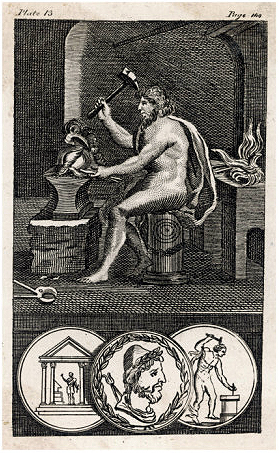
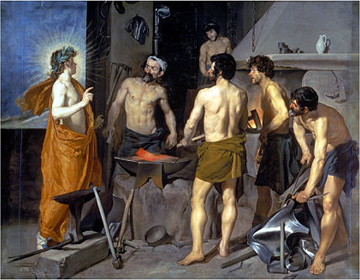
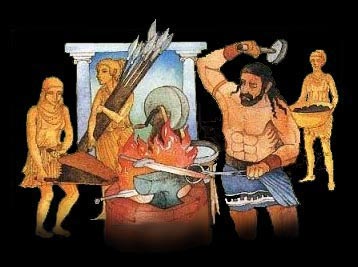
Hephaestus became the smith and
manufacturer of art, arms and armor for gods and heroes, using a volcano
as his forge. According to the
Iliad
he is married to Aglaia, one of the Graces, but in the
Odyssey
he is said to be married to Aphrodite.
2. Also known as the
"Ghost Planet" (Vulcan), celestial body that was thought to be
the closest planet to the Sun, circling it inside the orbit of Mercury,
but that it was later proven to do not exist.
The belief in the
existence of Vulcan sprung in the 17th century due to irregularities in
Mercury's motion that seemed to signal the existence a planet inside
Mercury's orbit. French mathematician and astronomer Urbain Jean Joseph Le
Verrier —
made world famous by the discovery of Neptune on the basis of his
calculations — was the one that believed so, and his faith in the planet
was never shaken, even though the only chance of glimpsing it would be
either to catch it in transit across the Sun's face, or identify it at the
time of a total solar eclipse.
In 1859 Lescarbault, a
French country doctor and amateur astronomer, announced that he had seen
the planet in transit; Le Verrier made haste to see him —
and accepted the story. Confirmation was lacking, but there was a revival
of interest in 1878, when two well-known observers —
Swift and Watson —
surveyed the neighborhood of the totally eclipsed Sun and reported finding
not one Vulcan, but several. Again, no proof or confirmation was
forwarded.
Vulcan does not exist,
and never did; the hunt for it was finally abandoned after the total solar
eclipse of 1929.
|
Related online classes and learning:
--
Ancient Civilizations (World History Part
1).
This exciting self-paced history course
will examine the ancient civilizations that dominated historical records
between the time periods of 3000 B.C. to 1200 B.C.
Click
HERE to enroll.
--
For more
new age and alternative beliefs
online classes,
click HERE.
|
|
Recommended
software:
-- Click
HERE for more related
software.
Recommended
videos:
Other related video titles:
--
Clash of the Titans DVD.
--
Greek Gods.
--
Jason and the
Argonauts (1963).
--
Jason and the Argonauts (2000).
--
Oracle at Delphi.
--
Powerful Gods of
Mt. Olympus.
--
Secrets of Delphi.
--
Timeless Tales:
Myths Ancient Greece 2.
--
Who's Who in Greek and Roman Mythology.
--
Click
HERE for more related
videos.
Recommended art prints and posters:
-- Click
HERE for more related
art prints and posters.
Recommended books:
Other related titles:
--
Adventures of the
Greek Heroes.
--
Ancient Greek
Mythology.
--
Ancient Myth and
Philosophy in Peter Russell's Agamemnon in Hades.
--
Ancient Roman
Mythology.
--
Apollo: Origins
and Influence.
--
Apollo the
Wolf-God.
--
Apollonius
Rhodius's Argonautika: The Story of Jason and the Argonauts.
--
Approaches to
Greek Myth.
--
Bulfinch's
Mythology.
--
Bulfinch's Mythology: The Illustrated Age of Fable.
--
Centaurs and
Amazons.
--
Centaurs of Many
Lands.
--
Classical Myth.
--
Classical Mythology: Images and Insights.
--
Cyclops.
--
D'aulaire's
Book of Greek Myths.
--
Dictionary of
Classical Mythology.
--
Dictionary of
Roman Religion.
--
Did the Greeks
Believe in Their Myths?: An Essay on the Constitutive Imagination.
--
Didyma: Apollo's
Oracle Cult and Companions.
--
Draw Fantasy:
Dragons, Centaurs, and Other Mythological Characters.
--
Eleusis:
Archetypal Image of Mother and Daughter.
--
Favorite Greek Myths.
--
Gods and Heroes:
Myths and Epics of Ancient Greece.
--
Encyclopedia of Classic Mythology.
--
Gods and Heroes;
The Story of Greek Mythology.
--
Gods, Heroes and
Men of Ancient Greece.
--
Greek and
Egyptian Mythologies.
--
Greek and Roman
Mythology A to Z: A Young Reader's Companion.
--
Greek Gods and
Heroes.
--
Greek Myths.
--
Greek Myths:
Gods, Heroes and Monsters: Their Sources, Their Stories and Their Meanings.
--
Greek Religion.
--
Heaven, Hell, and Hades; A Historical and Theological Survey of Personal
Eschatology.
--
Heroes, Gods and
Monsters of Greek Myths.
--
Hercules: The
Wrath of Poseidon.
--
Hydra and Kraken,
Or, the Lore and Lure of Lake-Monsters and Sea-Serpents.
--
Jason and the
Argonauts (Library of Myths and Legends Series).
--
Jason and the
Golden Fleece.
--
Lord of the Sky:
Zeus.
--
Lost Goddesses of
Early Greece: A Collection of Pre-Hellenic Myths With a New Preface.
--
Medusa (Monsters
of Mythology).
--
Medusa: Solving
the Mystery of the Gorgon.
--
Mythology.
--
Mythology (J.
Weigel).
--
Mythology:
Timeless Tales of Gods and Heroes.
--
Myths of Greece
and Rome.
--
Myths of the
Greeks and Romans.
--
Olympus.
--
Orpheus and Greek
Religion: A Study of the Orphic Movement.
--
Perseus.
--
Prolegomena to
the Study of Greek Religion (Mythos).
--
Simon
& Schuster Book of Greek Gods and Heroes.
--
Snake Dreamer.
--
Snake Hair: The
Story of Medusa (All Aboard Books Reading Level 2).
--
The Age
of Fable.
--
The Argonautika:
The Story of Jason and the Quest for the Golden Fleece.
--
The Centaur.
--
The Centaur
(Supernatural & Occult Fiction).
--
The Chiron
Dictionary of Greek & Roman Mythology: Gods and Goddesses, Heroes, Places, and Events
of Antiquity.
--
The Deadly Power
of Medusa.
--
The Dictionary of
Classical Mythology.
--
The Encyclopedia
of Mythology: Gods, Heroes, and Legends of the Greeks and Romans.
--
The Gardens of
Adonis: Spices in Greek Mythology.
--
The Goddess :
Mythological Images of the Feminine.
--
The Gods and
Goddesses of Olympus.
--
The Golden Fleece
and the Heroes Who Lived Before Achilles.
--
The Greeks and
Their Gods.
--
The Greek Myths.
--
The Heroes of the
Greeks.
--
The
Hydra (Monsters of Mythology).
-- The Library of Greek Mythology.
--
The MacMillan
Book of Greek Gods and Heroes.
--
The Myth of
Apollo and Marsyas in the Art of the Italian Renaissance: An Inquiry into the Meaning of
Images.
--
The Myths of
Greece & Rome.
--
The Oresteia:
Apollo & Bacchus.
--
The Penguin
Dictionary of Classical Mythology.
--
The Stellar Almanac: A History and Tour Guide of the Infernal Kingdom of
Hades.
--
The Story of Hercules.
--
The Trackers of
Oxyrhynchus: The Delphi Text 1988.
--
The Warrior
Goddess, Athena.
--
Twelve
Labors of Hercules.
--
Voyage to Olympus.
--
Who's Who in
Classical Mythology.
--
Women of
Classical Mythology: A Biographical Dictionary.
--
Writer's Complete
Fantasy Reference: An Indispensible Compendium of Myth and Magic.
--
Click
HERE for more related
books.
|
Further info:
Hephaestus / Vulcan.
| |
|
|

SKEPTICAL ENQUIRER,
the magazine providing
access to facts regarding the scientific investigation of claims of the
paranormal from a skeptical point-of-view, enabling readers to separate
fact from myth in the flood of occultism and pseudoscientific theories
presented in today's culture.
|
|
|
|
|
|
|

GHOST!
The periodical dedicated to
ghosts and their research. Can a ghost aid investigators in solving a
ninety year old murder? Is your house haunted? What are the latest
theories regarding life after death? Within Ghost!
readers will find the answers to these questions and the latest
developments in the field of ghost research.
|
|
|
|
|
|
|

| |
|
|
This website is best viewed with the latest
versions of
Microsoft
Internet Explorer,
Firefox or
Netscape.
Occultopedia
makes extensive use of
Flash and Scripting in its pages and interface. Make certain your browser
permissions are set
accordingly and that you have the latest
Flash plug-in for the full experience, proper look and accurate
layout.
If using
Microsoft
Internet Explorer 7, clicking (or pressing the SPACEBAR or ENTER) on the
Flash graphics is necessary to activate it. If using the latest versions
of
Firefox or
Netscape, adjusting the browser
trust permissions to "ENABLE MAXIMUM SITE FUNCTIONALITY" is required to fully
enjoy Occultopedia's features and
Flash graphics. You can do it with confidence. This site does not contain any viruses or any malicious software
or script.
|
|
As you may have noticed, Occultopedia is being updated.
Navigation areas are completed, but the word definition pages are not. The
layout in these pages might not look as good as they should. Updating them
may take a while, so please, be patient and understanding. I am only one
person working on this site in my spare time.
As soon as these updates are concluded I will begin setting up the
Forums, so we can all discuss the
occult, paranormal and extraordinary, and whatever else we please.
Registration will be required.
Occultopedia's images and art are also undergoing an adjustment to
Flash based graphics. This process may take some time as well, so again, be
patient and understanding.
|
|
|
|
| |
|
|
Occultopedia is the genuine article, the
original and the best internet index of the extraordinary and uncanny,
shamelessly copied by many, but never equaled. Online since the
early 90s — at first in a free web space provider, and in 1997 finally
with its own domain name and hosting — Occultopedia still is the
principal online resource for those looking for the unexplained, the
curious and the unusual. |
|
Occultopedia respects your privacy. As
such, no cookies or any other tracking software will be installed as a
part of this website's original programming. I do not seek to obtain any personal information
beyond what is volunteered through electronic communications
(e.g. emails & forms).
|
|
Occultopedia may appear to be a for profit site, but my site is
not really a commercial one. All of the commercial links are from affiliate
programs, and the little revenue I get from these is to pay for hosting,
bandwidth — that can be quite costly if you have a lot of traffic, graphics and
pages — and any other expenses related to Occultopedia's upkeep and maintenance.
For more details, visit my
ordering
information page.
Occultopedia is a
FREE online
resource available to the whole world. Usage of my word definitions and articles
by educational institutions, teachers and students alike, is here by granted. For more information, please consult my
intellectual property rights, warranties and
disclaimers information page. Support Occultopedia and make it your
online shopping
destination. If you prefer, you can also make a donation.
|
|
HELP FOOT THE BILL: this website
is created and maintained by one guy, who also pays the hosting bill.
Please donate if you like and/or use Occultopedia.
|
|
Participate in Occultopedia and submit a word
definition or article for the occult encyclopedia at my
entry submission
page. If you would like to suggest a web site or page for
addition into Occultopedia's links database, please go to my
URL submission page.
|
|
|
|
|
Site
creation and design
by M. V. G.
|
Copyright
© Occultopedia™ . All rights reserved. |
| |