Artemis (Roman Diana)
The Greek goddess identified by the Romans with the Italian goddess Diana, and also called Cynthia, from her birthplace, Mount Cynthus in Delos. She was the daughter of Zeus and Leto and the twin sister of Apollo.
A virgin huntress, she was associated with uncultivated places and wild animals, and was also a primitive birth-goddess.
She was also known as the Lady of Wild Things and the Huntsman-in-chief to the gods, an odd office for a woman. Like a good huntsman, she was careful to preserve the young; she was "the protectress of dewy youth" everywhere. Nevertheless, with one of those startling contradictions so common in mythology, she kept the Greek Fleet from sailing to Troy until they sacrificed a maiden to her. In many another stories, too, she is fierce and revengeful. On the other hand, when women died a swift and painless death, they were held to have been slain by her silver arrows — it was believed that she brought natural death with her arrows.
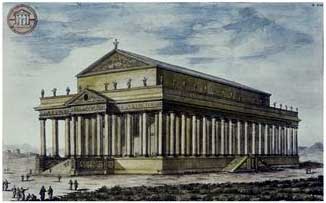
The biblical reference to the Temple of Diana of the Ephesians (Acts 19) is really to the Artemisium at Ephesus, one of the seven wonders of the ancient world. A famous statue of her there was covered all over with breasts to mark her connection with childbirth. Her name has been associated with Greek artemia, 'safety', and ‘soundness’, alluding to her virginity.
See Zeus, Apollo, Hermes, Delphi, Troy, Olympians, Greeks, Hera, Hades, Bacchus, Centaurs, Cerberus, Daedalus, Dionysus, Vulcan, Mars, Oracle, Tarpeian Rock, Tartarus, Telegonus, Telemachus, Mystic Gifts and Charms - New Age Gift Shop & Wicca and Pagan Supplies, Love Spells -- Use these powerful love spells to help you find and keep your true love, The Chakra Store, The Tarot Store, Divination & Scrying Tools and Supplies, Unique Amulets, Talismans, Good Luck Charms, and Love Tokens, Powerful Witch Doctor Spell Kits, Powerful Spells - Cast by Andreika the Witch, Webmasters Make $$$, AzureGreen - Celebrating All Paths to the Divine, ISIS - Tools for Your Soul's Journey, and The Pyramid Collection - Myth, Magick, Fantasy and Romance.
Sources: (1) Cooper, J.C. (Editor), Brewer's Book of Myth and Legend, Cassell Academic Publishing; (2) Evans, Bergen, Dictionary of Mythology, Dell Publishing Co., Inc.; (3) Dixon-Kennedy, Mike, Encyclopedia of Greco-Roman Mythology, ABC-Clio Inc. Publishers; (4) Ayto, John, Brewer's Dictionary of Phrase & Fable, Collins Reference Publishing.
| | |



















 Change Your Life!



