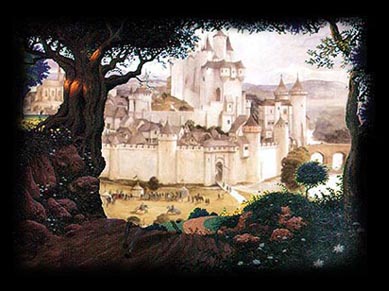
To say that this place or any other is Camelot invites the question, what meaning can be attached to such an identification?
Crucial to the Camelot problem are the proofs that about the first quarter of the 6th century AD, Arthur's presumed period, the hill-fort beside South Cadbury (Cadbury Castle) was in fact the stronghold of a wealthy and powerful British ruler, who imported luxuries from the eastern Mediterranean, put up at least one substantial building on the piece of ground called King Arthur's Palace, and refurbished the defenses by superimposing a huge dry stone rampart of Celtic type, for which there are no known contemporary parallels anywhere else in Britain.
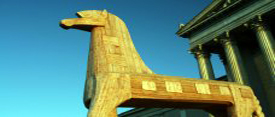
Interpreted in the light of other archeological findings, these results at least suggest an acceptable meaning for the phrase 'Arthurian Britain', and for Camelot as a reality around which legends have grown, as they did around the considerably smaller citadel of Troy.
Whatever the precise truth about the real Arthur, he symbolizes an historical fact which is no longer disputed. The British Celts, having lived under the rule of Rome and received a degree of Roman civilization, rallied against the first Anglo-Saxon invaders and threw them back. During the first half of the 6th century, the Britons were generally in the ascendant throughout most of what is now England, and in the Scottish Lowlands. During a large part of this time they enjoyed relative peace and prosperity. Arthur appears to have been the British commander to whom the main credit was due. He may or may not have had some royal title, but his legendary reign is based far more on his exploits as a war-leader and on the period of peace which his victories secured.
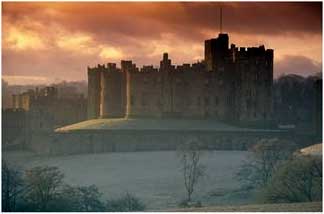
Cadbury Castle, easily the largest and most formidable of the known British strongholds of that period, as pointed before fits logically into the picture as the headquarters of the greatest British leader. In that sense it could be the 'real Camelot' of the 'real Arthur'. Furthermore, its archeological context includes other places that figure in the Arthurian legend. But, according to some scholars, at Cadbury Castle there can never have been a medieval city of the kind imagined by Sir Thomas Mallory. Here, the issue has been raised more insistently by the work of the Camelot Research Committee, which in 1966 began to excavate the hill. Since then traces have been found of several human occupations extending over a long time. Thus at Tintagel in Cornwall, while there is no sign of the pre-Norman castle where Arthur was allegedly born, the famous headland is now known to have been inhabited in his time. Its occupants were British monks, and the imported pottery used by their community has supplied key clues to the dating and interpretation of other sites, including Cadbury itself.
At a second Iron Age hill-fort, Castle Dore in Cornwall, traces have been found of 6th century resettlement by a west country chieftain. He built a timber hall, and may have been the original of King Mark in the Tristan romance. Further hill-top dwellings have been discovered in Wales, and also on Glastonbury Tor. The Tor seems to have been the home of a certain Melwas, who appears in an early tale of Arthur and later becomes 'Meleagant' or 'Mellyagraunce'.
The story of King Arthur was not born as a single cohesive narrative, but began life as a scattered collection of tales that originally probably had nothing to do with any discernible historical figure. Camelot, in the same manner, probably never was a single specific city or place, but probably a symbol created to represent the home fortress of an archetypical heroic war lord.
This website is best viewed with the latest
versions of
Microsoft
Internet Explorer or
Firefox.
Occultopedia
makes extensive use of
Flash and Scripting in its pages and interface. Make certain your browser
permissions are set
accordingly and that you have the latest
Flash plug-in for the full experience, proper look and accurate
layout. You can do it with confidence. This site does not contain any viruses, malicious software
or scripts.
Occultopedia is the genuine article, the
original and the best internet index of the extraordinary and uncanny,
shamelessly copied by many, but never equaled. Online since 1995 — at first in a free web space provider
(Tripod.com), and in 1997 finally
with its own domain name and hosting — Occultopedia still is the
principal online resource for those looking for the unexplained, the
curious and the unusual.
Occultopedia respects your privacy. As
such, no cookies or any other tracking software will be installed as a
part of this website's original programming. I do not seek to obtain any personal information
beyond what is volunteered through electronic communications
(e.g. emails & forms).
Occultopedia may appear to be a for profit site, but my site is
not in reality a commercial one. All of the commercial links are from affiliate
programs, and the little revenue I get from these is to pay for hosting,
bandwidth — that can be quite costly if you have a lot of traffic, graphics and
pages — and any other expenses related to Occultopedia's upkeep, support, and maintenance.
For more details, visit my
ordering
information page.
Occultopedia is a
FREE online
resource available to the whole world. Usage of my word definitions and articles
by educational institutions, teachers and students alike, is here by granted.
Reproduction for profit, and for display in another web site is strictly
forbidden, and will be handled as copyright infringement and prosecuted to the
full extent of the law. However, if you follow
some simple guidelines,
I will grant permission for limited reproduction. For more information, please consult my
intellectual property rights, warranties and
disclaimers information page. Support Occultopedia and make it your
online shopping
destination. If you prefer, you can also make a donation.
HELP FOOT THE BILL: this website
is created and maintained by one guy, who also pays the hosting bill.
Please donate if you like and/or use Occultopedia.
Participate in Occultopedia and submit a word
definition or article for the occult encyclopedia at my
entry submission
page. If you would like to suggest a web site or page for
addition into Occultopedia's links database, please go to my
URL submission page.






 .
. .
.