Alchemy
An ancient pseudoscience chiefly concerned with the transmutation of base metals into gold and silver, with the discovery of a single effective cure for all diseases, with a way to extend life indefinitely, and with the manufacture of artificial life.
Alchemy can be described as a method of investigating nature in a spiritually creative way, the skill that transforms the impure into the pure. Symbolically, alchemy is a mystical art for human spiritual transformation into a higher form of being.
 | | | | |
| | |
| |
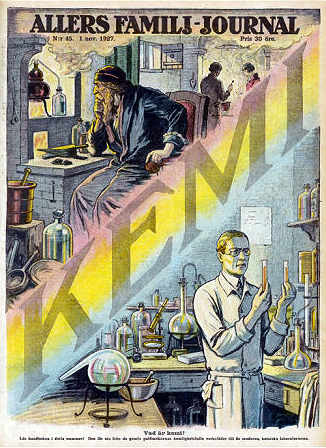
No doubt the word alchemy is an Arabic one, but where it came from, no one knows exactly. A popular explanation is that it originally meant "the art of the land of Khem," Khem being the name the Arabs gave to Egypt, since it was from there that they acquired their knowledge of this strange science. Another possibility is that it could be derived from the combination of the Arabic words al (the) and kimya (chemistry). E. A. Wallis Budge, in his Egyptian Magic, states that it is possible that it may be derivative from the Egyptian word khemeia, that is to say "the preparation of the black ore," or "powder," which was regarded as the active principle in the transmutation of metals. To this name the Arabs attached the article al, thus al-khemeia, or alchemy.
Whatever the origin of the word, since the dawn of human consciousness, long before alchemy's rising, the seductive gleaming of gold captured man's imagination. Over 40,000 years ago, Paleolithic cave dwellers gathered bits of the metal, hoarding them in their caverns, and the ancient Incas thought of it as "the sweat of the sun," used to make everything, from ceremonial tiaras to fishhooks. To Hindu sages it was "the mineral light," a physical token of divine intelligence. Pindar, the Greek poet, called it "the child of Zeus."
Gold's possession was indicative of wealth and power and, known as the perfect metal, it soon acquired symbolic meaning, standing for excellence, wisdom, light and flawlessness, and always carrying an aura of mystical power. Merchants traded for it, princes went to war for it, and increasingly, through the ages, kings and commoners alike solicited the aid of supernatural intervention to obtain it, motivated by the ancient belief that magical powers were present in fluxes and alloys.
The obvious goal of alchemy was the production of gold from base metal, but the hidden part of the quest is mainly forgotten. The alchemist was also searching for a way to reach spiritual perfection, and believed that purifying base metals into the perfect Sun metal, gold, was the outward symbol of the transmutation of his soul from an ordinary state to a condition of union with God.
Alchemy surfaced in China and in Egypt during the early centuries of this era, but its precise origins and antiquity are exceptionally difficult to ascertain. As an art, it is undoubtedly very ancient; its starting point is likely to have been the primitive process to which craftsmen learned, in the second millennium before Christ, to smelt iron and other metals, and hoped to find a way of producing rarer substances like silver and gold.
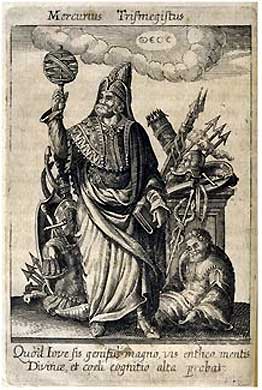
According to ancient tradition, the originator of alchemy was Hermes Trismegistus, a legendary figure said to have lived some 2,500 years BC, and who takes the role of teacher in a series of dialogues of uncertain and mysterious origin. Another legend connects alchemy with Adam and Eve at the time they were expelled from the Garden of Eden. The story goes that an angel at the gate took pity of the two as they were leaving, and instructed them in the secrets of astrology and alchemy. As they descended from the spiritual realm to the material world. these secrets would also change, eventually becoming astronomy and chemistry, but Adam and Eve would be able to remember the spiritual source of these material sciences, astrology and alchemy. By virtue of this remembering, and diligent practice, they would eventually find their way back to the Garden.
On yet another legend, the mummy of Hermes Trismegistus was found in an obscure chamber of the Great Pyramid of Giza, holding an emerald tablet in its hands. The words written on the tablet revealed the alchemical belief that "It is true and without falsehood and most real: that which is above is like that which is below, to perpetuate the miracles of one thing. And as all things have been derived from one, by the thought of one, so all things are born from this thing, by adoption." Within the secrets inscribed on the tablet was the "most powerful of all powers," the process by which the world was created and by which all "subtle things" might penetrate "every solid thing," and by which base material might be transformed into precious metals and gems.
In the East, in China and India, alchemy probably started with medicine and meditation. It was associated with Taoist philosophy and professed to transmute base metals into gold by use of a 'medicine'. The gold so produced was thought to have the ability to cure diseases and to prolong life. There are references to alchemical processes in the Nei Ching (The Yellow Emperor's Book of Medicine), whose origin is lost in the dim past.
In the West, in Egypt, alchemy almost certainly developed from metallurgy and glass-making on the one hand, and the pyramid mysteries and initiation rites on the other. The methods of transmutation of metals were kept secret by temple priests. Those recipes became widely known (2nd century) at the academy in Alexandria. There is, moreover, a strong possibility that the Jews in Egypt from the time of Moses influenced visionary or spiritual alchemy through Kabbalah. The connections between the Egyptian theogony and the Kabbalistic sephiroth are striking.
| | |