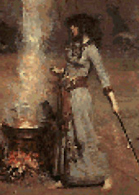
Group of peoples that occupied lands stretching from the British Isles to Galatia. They included the Irish, Manx, Welsh, Cornish, Briton and Scottish Gaelic and the people who speak these languages. The term was formerly applied by the Greeks and Romans to the peoples of western Europe in general. Legend goes that Celtina, daughter of Britannus, had a son by Hercules, who was named Celtus and was the progenitor of the Celts.
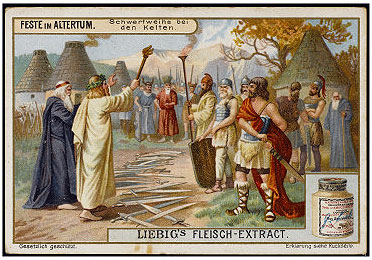
According to Lewis Spence, magic among the Celtic peoples in ancient times was so closely identified with Druidism that its origin may be said to have been Druidic. Celtic origin and its relation to Druidism, however, is a question upon which much discussion has been lavished. Some authorities, including Sir John Rhys, believe it to have been of non-Celtic and even non-Aryan origin; that is, the earliest non-Aryan or so-called Iberian or Megalithic people of Britain introduced the immigrant Celts to the Druidic religion.
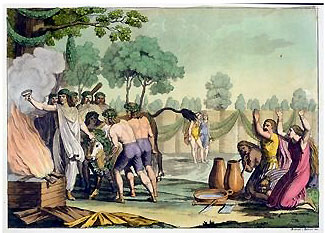
Many of the ancient magical spells used among the Druids survived until a comparatively late period — the names of saints being substituted for those of Celtic deities. In pronouncing incantations, the usual method employed was to stand upon one leg and point with the forefinger to the person or object on which the spell was to be laid, at the same time closing an eye, as if to concentrate the force of the entire personality upon that which was to be placed under the spell. All magic rites were accompanied by spells, and Druids often accompanied an army to assist by their magic in confounding the enemy.
A manuscript preserved in the Monastery of St. Gall, dating from the 8th or 9th century, contains magic formulas for preserving butter and healing certain diseases in the name of the Irish god of medicine, Diancecht. These bear a close resemblance to Babylonian and Etruscan spells, and this goes to strengthen the hypothesis often put forward that Druidism had an eastern origin.
This website is best viewed with the latest
versions of
Microsoft
Internet Explorer or
Firefox.
Occultopedia
makes extensive use of
Flash and Scripting in its pages and interface. Make certain your browser
permissions are set
accordingly and that you have the latest
Flash plug-in for the full experience, proper look and accurate
layout. You can do it with confidence. This site does not contain any viruses, malicious software
or scripts.
Occultopedia is the genuine article, the
original and the best internet index of the extraordinary and uncanny,
shamelessly copied by many, but never equaled. Online since 1995 — at first in a free web space provider
(Tripod.com), and in 1997 finally
with its own domain name and hosting — Occultopedia still is the
principal online resource for those looking for the unexplained, the
curious and the unusual.
Occultopedia respects your privacy. As
such, no cookies or any other tracking software will be installed as a
part of this website's original programming. I do not seek to obtain any personal information
beyond what is volunteered through electronic communications
(e.g. emails & forms).
Occultopedia may appear to be a for profit site, but my site is
not in reality a commercial one. All of the commercial links are from affiliate
programs, and the little revenue I get from these is to pay for hosting,
bandwidth — that can be quite costly if you have a lot of traffic, graphics and
pages — and any other expenses related to Occultopedia's upkeep, support, and maintenance.
For more details, visit my
ordering
information page.
Occultopedia is a
FREE online
resource available to the whole world. Usage of my word definitions and articles
by educational institutions, teachers and students alike, is here by granted.
Reproduction for profit, and for display in another web site is strictly
forbidden, and will be handled as copyright infringement and prosecuted to the
full extent of the law. However, if you follow
some simple guidelines,
I will grant permission for limited reproduction. For more information, please consult my
intellectual property rights, warranties and
disclaimers information page. Support Occultopedia and make it your
online shopping
destination. If you prefer, you can also make a donation.
HELP FOOT THE BILL: this website
is created and maintained by one guy, who also pays the hosting bill.
Please donate if you like and/or use Occultopedia.
Participate in Occultopedia and submit a word
definition or article for the occult encyclopedia at my
entry submission
page. If you would like to suggest a web site or page for
addition into Occultopedia's links database, please go to my
URL submission page.









 .
. .
. .
. .
.




 Change Your Life!