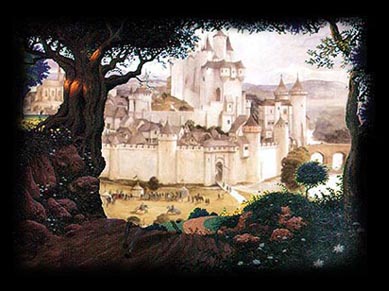
The capital of King Arthur where, according to legend, he reigned over the Britons before the Saxon conquest.
Camelot is not located on any authentic early map. However, 'cam' and 'camel' do occur as elements in British place-names of pre-Saxon origin.
According to romances, Camelot was named after a pagan king called Camaalis. At the time Joseph of Arimathea arrived in Britain, it was the most important city of the country. In Joseph's time, King Agrestes ruled it.
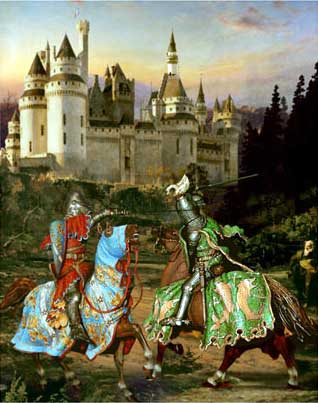
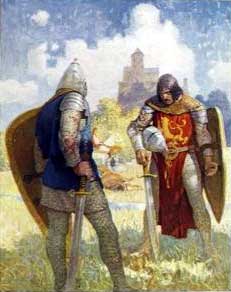
The hero of a famous cycle of legends and romances, Arthur was said to have been born at Tintagel in Cornwall. He became King of Britain and held court at Camelot as the leader of a band of noble warriors, the Knights of the Round Table.
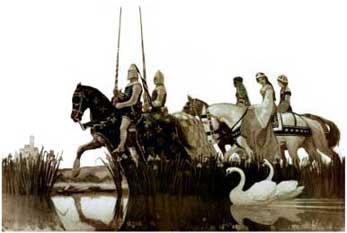
The knights rode out to seek adventure and great deeds, notably in the quest of the Grail — in Christian legend the holy cup used by Christ at the Last Supper. Arthur was betrayed by his wife Guinevere and his nephew, or son, Mordred. Wounded in battle against Mordred, he was carried away by three fairy queens to Avalon, the land of immortal heroes, from which he will return to lead his countrymen in the time of their greatest peril.
The oldest known stories of Arthur never refer to Camelot, as such. The King first holds court there explicitly in the romance 'Lancelot,' written by Chretien de Troyes between 1160 and 1180. Three centuries later Sir Thomas Mallory makes it the chief city of the realm, where the Round Table is housed. He sometimes equates it with Winchester, yet in one passage of his work it seems to be north of Carlisle. Baron Alfred Tennyson never attempts to localize Camelot: in the 'Idylls of the King,' it is symbolic, in the poet's own words 'of the gradual growth of human beliefs and institutions, and of the spiritual development of man.' The name in fact has tended to become evocative rather than geographical. Thus the conversion of T. H. White's Arthur cycle into a musical involved an almost inevitable change of title from 'The Once and Future King' to 'Camelot.'
Local legends and antiquarian guesswork have proposed several sites for this elusive city. One is Colchester, the RomanCamulodunum. Another theory places it near Tintagel, Arthur's reputed Cornish birthplace, in a district which contains the River Camel and Camelford. However, the candidate with the strongest claim to a genuine underlying tradition is Cadbury Castle in Somerset. The 'Castle' is an earthwork fort of the pre-Roman Iron Age on an isolated hill 500 feet high, which looks over the Vale of Avalon to Glastonbury Tor in the distance. The ramparts surround an enclosure of 18 acres on top of the hill. The village of Queen Camel — once simply Camel — is fairly close, as is the River Cam. The antiquary John Leland, in the reign of Henry VIII, speaks of local people referring to the hill-fort as 'Camalat' and as the home of Arthur. Folklore of immemorial age has clustered round it. A well inside the ramparts is called King Arthur's Well, and the summit plateau King Arthur's Palace. The King is said to lie asleep in a cave and at midsummer the ghostly hoof-beats of his knights can be heard.
This website is best viewed with the latest
versions of
Microsoft
Internet Explorer or
Firefox.
Occultopedia
makes extensive use of
Flash and Scripting in its pages and interface. Make certain your browser
permissions are set
accordingly and that you have the latest
Flash plug-in for the full experience, proper look and accurate
layout. You can do it with confidence. This site does not contain any viruses, malicious software
or scripts.
Occultopedia is the genuine article, the
original and the best internet index of the extraordinary and uncanny,
shamelessly copied by many, but never equaled. Online since 1995 — at first in a free web space provider
(Tripod.com), and in 1997 finally
with its own domain name and hosting — Occultopedia still is the
principal online resource for those looking for the unexplained, the
curious and the unusual.
Occultopedia respects your privacy. As
such, no cookies or any other tracking software will be installed as a
part of this website's original programming. I do not seek to obtain any personal information
beyond what is volunteered through electronic communications
(e.g. emails & forms).
Occultopedia may appear to be a for profit site, but my site is
not in reality a commercial one. All of the commercial links are from affiliate
programs, and the little revenue I get from these is to pay for hosting,
bandwidth — that can be quite costly if you have a lot of traffic, graphics and
pages — and any other expenses related to Occultopedia's upkeep, support, and maintenance.
For more details, visit my
ordering
information page.
Occultopedia is a
FREE online
resource available to the whole world. Usage of my word definitions and articles
by educational institutions, teachers and students alike, is here by granted.
Reproduction for profit, and for display in another web site is strictly
forbidden, and will be handled as copyright infringement and prosecuted to the
full extent of the law. However, if you follow
some simple guidelines,
I will grant permission for limited reproduction. For more information, please consult my
intellectual property rights, warranties and
disclaimers information page. Support Occultopedia and make it your
online shopping
destination. If you prefer, you can also make a donation.
HELP FOOT THE BILL: this website
is created and maintained by one guy, who also pays the hosting bill.
Please donate if you like and/or use Occultopedia.
Participate in Occultopedia and submit a word
definition or article for the occult encyclopedia at my
entry submission
page. If you would like to suggest a web site or page for
addition into Occultopedia's links database, please go to my
URL submission page.






 .
. .
.