Behemoth
A monster in the religious traditions of the Hebrew, Christian and Muslim faiths.
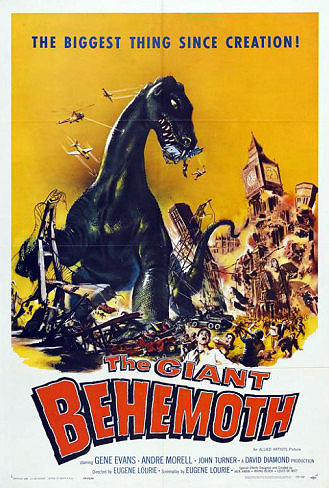
In the popular imagination the word Behemoth has come to mean any large creature, and, indeed, the Hebrew word behemoth simply means 'beasts'. But both Henri Boguet (1550-1619), the French demonologist, and Madame Helena Blavatsky, the 19th century Russian mystic, saw Behemoth as a demon — a symbol, like Leviathan, of darkness and evil.
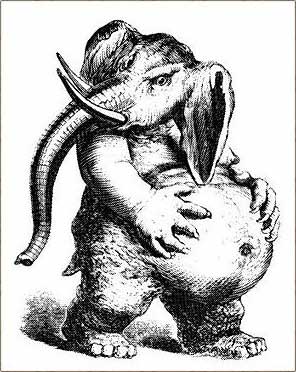
Demonically, as the name suggests, he was a huge soldier of Satan, usually depicted as an elephant with a big round belly, waddling on two feet. He was the infernal watchman, and also presided over the gluttonous banquets and feasts. It is said that he also enjoyed a certain renown for his voice, being regarded as Hell's official demonic singer.
The biblical description of Behemoth's habits and strength has led most zoologists to conclude that the creature is probably based on the hippopotamus — though a few opt for the elephant, a gigantic water buffalo or crocodile. The only line in Job that does not fit this identification is: "He makes his tail stiff like a cedar." English poet, visionary, and artist William Blake portrayed Behemoth (with the water monster Leviathan) in 'Illustrations of the Book of Job' (1825). He depicts the beast as a hippopotamus, with tusks, human ears, and a lion's tail.
According to legend, the Behemoth was the largest animal that lived on land. Jewish tradition tells us that it was fashioned from clay on the sixth day of creation; it also prophesied that at the coming of the Day of Judgment and the Messiah, the Leviathan and Behemoth would be locked in combat to the death. The resulting bodies would be food for the 'chosen' who had lived their lives in righteousness. However, the book of Job records that the Behemoth is the first of God's works. The Behemoth has bones like tubes of bronze and limbs like iron rods. Each day, the Behemoth gorges on the fodder produced by a thousand mountains. Because of this insatiable appetite, only one creature was created, thus preventing it from multiplying.
"Behold now behemoth, which I made with thee; he eateth grass as an ox. Lo now, his strength is in his loins, and his force is in the navel of his belly. He moveth his tail like a cedar: the sinews of his stones are wrapped together. His bones are as strong pieces of brass; his bones are like bars of iron. He is the chief of the ways of God: he that made him can make his sword to approach unto him. Surely the mountains bring him forth food, where all the beasts of the field play. He lieth under the shady trees, in the covert of the reed, and fens. The shady trees cover him with their shadow; the willows of the brook compass him about. Behold, he drinketh up a river, and hasteth not; he trusteth that he can draw up Jordan into his mouth. He taketh it with his eyes; his nose pierceth through snares."
(Job 40: 15-24)
At the time of the summer solstice, during the month of Tammuz, the Behemoth, its strength at its peak, rises upon its hind legs and lets out a fearful echoing roar. This loud roar is heard by all the animals in the world. Terrified, the wild predators become less ferocious and restrain themselves from preying on the flocks and herds for an entire year.
The Behemoth was created solely to be served as one of the delicacies during the messianic banquet at the end of days. The other delicacies are the Leviathan and the Ziz. The Behemoth may only be killed by the sword of his maker. Some accounts have the behemoth banished to living in the abyss with its enemy, the Leviathan.
In the Muslin tradition, Behemoth equates with the monstrous Bahamut, the vast monster that supports the earth in the cosmos.
See Leviathan, Shakespeare, Beelzebub, Satan, Heptameron, Demonology, Demonomancy, Grimoires, Mystic Gifts and Charms - New Age Gift Shop & Wicca and Pagan Supplies, Love Spells -- Use these powerful love spells to help you find and keep your true love, The Chakra Store, The Tarot Store, Divination & Scrying Tools and Supplies, Unique Amulets, Talismans, Good Luck Charms, and Love Tokens, Powerful Witch Doctor Spell Kits, Powerful Spells - Cast by Andreika the Witch, Webmasters Make $$$, AzureGreen - Celebrating All Paths to the Divine, ISIS - Tools for Your Soul's Journey, and The Pyramid Collection - Myth, Magick, Fantasy and Romance.
Sources: (1) Masello, Robert, Fallen Angels. . . and Spirits of the Dark, The Berkley Publishing Group; (2) Rose, Carol, Giants, Monsters, and Dragons: An Encyclopedia of Folklore, Legend, and Myth, W. W. Norton & Company; (3) van der Toorn, Karel (editor), Dictionary of Deities and Demons in the Bible, Wm. B. Eerdmans Publishing Company.
| | |









 .
. .
. .
. .
.





 Change Your Life!



