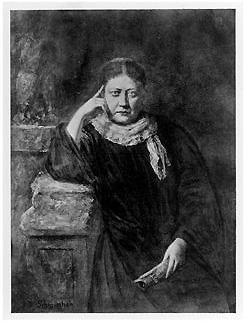
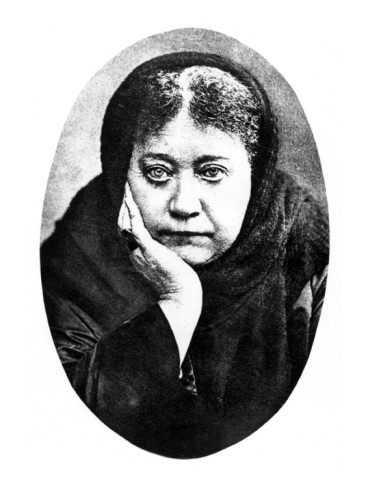
One of the most influential occult thinkers of the nineteenth century and cofounder of the Theosophical Society, Blavatsky was a Russian-born (July 31, 1831, German parents in Yekaterinoslav) American woman who left behind conflicting images of adventuress, author, mystic, guru, occultist, and charlatan.
Originally named Helena Hahn, she was an enigmatic personality, brought up in an atmosphere saturated with superstition and fantasy. She was married briefly in her teens to a Russian general, but left him and traveled widely in the East, including Tibet, in search of mysteries.
Returning to Russia after ten years of wanderings, Blavatsky supposedly exhibited various psychic powers. Allegedly, raps, whisperings, and other mysterious sounds were heard all over the house, objects moved about in obedience to her will, their weight decreased and increased as she wished, and winds swept through the apartment, extinguishing lamps and candles. She gave exhibitions of clairvoyance, discovered a murderer for the police, and narrowly escaped being charged as an accomplice.
Blavatsky traveled to Paris in 1858 and was introduced to the internationally famous medium Daniel Dunglas Home (1833–1886) and was so impressed by his paranormal abilities that she became a Spiritualist. When Blavatsky, in turn, sought to impress him with her own mediumistic talents, Home ignored her and informed her that she was a cheat.
In 1860 Blavatsky became severely ill. A wound below the heart, which she received from a sword cut in magical practice in the East, opened again, causing her intense agony, convulsions, and trance. After her recovery, friends and acquaintances claimed that her spontaneous physical phenomena had disappeared, but she insisted that, after the illness, they only occurred in obedience to her will.
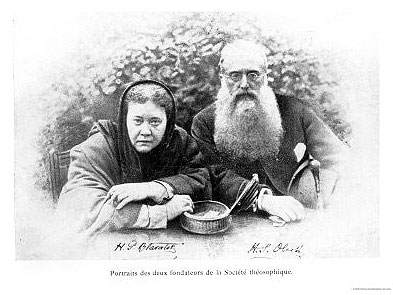
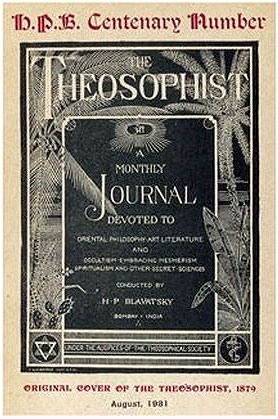
Blavatsky again went abroad, and, disguised as a man, she fought under Garibaldi and was left for dead in the battle of Mentana. She fought back to life, had a miraculous escape at sea on a Greek vessel that was blown up, and, in 1871 in Cairo, she founded the short lived Societé Spirite. She then went to America in 1873, and in 1875, with Colonel Henry Steel Olcott, founded the Theosophical Society in New York. It professed to expound the esoteric tradition of Buddhism and aimed at forming a universal brotherhood of man; studying and making known the ancient religions, philosophies, and sciences; investigating the laws of nature; and developing the divine powers latent in man. It was claimed to be directed by secret Mahatmas, or Masters of Wisdom.
Throughout her career Blavatsky claimed to perform feats of medium-ship, levitation, telepathy and clairvoyance. Her psychic powers were widely acclaimed and attracted many converts to Theosophy, including Annie Besant, who's home became the headquarters of the Theosophical Society in London. In 1885 the Society for Psychical Research published a damning report (The Hodgson Report) alleging fraud and trickery by Blavatsky and her associates.
The Hodgson Report left a deep shadow over Blavatsky’s final years. Annie Besant’s conversion to Theosophy resulted after she had been requested by W. T. Stead to review The Secret Doctrine in 1889. Blavatsky suggested that she read the Hodgson Report before forming any firm conclusions, but Besant was not adversely affected and requested to be Blavatsky’s pupil. Thereafter Besant provided a secure refuge for the aging Theosophist at her own home in London. In her last years here, Blavatsky became the center of a memorable group of talented individuals. She died peacefully May 5, 1891.
Blavatsky’s detractors considered her to have been a hoaxster, a fraud, and a deceiver, while her followers revered her as a genius, a veritable saint, and a woman of monumental courage who had struggled against an incredible array of adversities and adversaries to fashion a modern mystery school without equal. Foe and follower alike conceded that she was a unique, sometimes overpowering, personality who had apparently traveled the world in search of spiritual truths and who had survived physical crises and challenges that would certainly have discouraged — or killed — a less indomitable individual.
Blavatsky writings include Isis Unveiled (1877) and The Secret Doctrine (1888). She had no problem with Christianity, but she preferred focusing on its esoteric traditions, which united it with all other religions. She popularized the study of reincarnation and past lives in Europe and the United States and introduced many occult and metaphysical concepts which flourished in the New Age Movement of the 1970s.
This website is best viewed with the latest
versions of
Microsoft
Internet Explorer or
Firefox.
Occultopedia
makes extensive use of
Flash and Scripting in its pages and interface. Make certain your browser
permissions are set
accordingly and that you have the latest
Flash plug-in for the full experience, proper look and accurate
layout. You can do it with confidence. This site does not contain any viruses, malicious software
or scripts.
Occultopedia is the genuine article, the
original and the best internet index of the extraordinary and uncanny,
shamelessly copied by many, but never equaled. Online since 1995 — at first in a free web space provider
(Tripod.com), and in 1997 finally
with its own domain name and hosting — Occultopedia still is the
principal online resource for those looking for the unexplained, the
curious and the unusual.
Occultopedia respects your privacy. As
such, no cookies or any other tracking software will be installed as a
part of this website's original programming. I do not seek to obtain any personal information
beyond what is volunteered through electronic communications
(e.g. emails & forms).
Occultopedia may appear to be a for profit site, but my site is
not in reality a commercial one. All of the commercial links are from affiliate
programs, and the little revenue I get from these is to pay for hosting,
bandwidth — that can be quite costly if you have a lot of traffic, graphics and
pages — and any other expenses related to Occultopedia's upkeep, support, and maintenance.
For more details, visit my
ordering
information page.
Occultopedia is a
FREE online
resource available to the whole world. Usage of my word definitions and articles
by educational institutions, teachers and students alike, is here by granted.
Reproduction for profit, and for display in another web site is strictly
forbidden, and will be handled as copyright infringement and prosecuted to the
full extent of the law. However, if you follow
some simple guidelines,
I will grant permission for limited reproduction. For more information, please consult my
intellectual property rights, warranties and
disclaimers information page. Support Occultopedia and make it your
online shopping
destination. If you prefer, you can also make a donation.
HELP FOOT THE BILL: this website
is created and maintained by one guy, who also pays the hosting bill.
Please donate if you like and/or use Occultopedia.
Participate in Occultopedia and submit a word
definition or article for the occult encyclopedia at my
entry submission
page. If you would like to suggest a web site or page for
addition into Occultopedia's links database, please go to my
URL submission page.












 .
.









 Change Your Life!