Atlantis (page 2)
According to Plato, the capital of Atlantis was a 14 mile wide complex of canals, walls, gardens, barracks and a public race track, arranged in circles around a royal palace and temple to the sea god Poseidon, the city's patron.
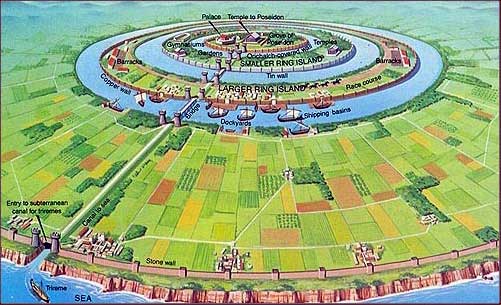
Plato's narratives, from the Timaeus and Critias, are the sole ancient source of the Atlantis legend. Yet the awe-inspiring scale of the drama ― of a wealthy, powerful and corrupt continent, abruptly consumed by some great natural cataclysm ― has gripped the Western imagination ever since.
|

Underworld: Flooded Kingdoms of the Ice Age
A physical and intellectual
journey, a worldwide exploration diving for the underwater ruins
of a lost civilization, this book follows clues in ancient
scriptures and mythology and in the scientific evidence of the
flood that swept the Earth at the end of the last Ice Age. This
text explores the question of early humans swept away by the
catastrophe. Who were these populations - pre-civilized
hunter-gatherers or more sophisticated peoples altogether? The
text is written as a personal adventure involving the reader in
the travels, the practicalities and the risks while developing
the larger themes along the way, building up to the explosive
revelation of a global mystery.

|
| |
The modern myth of Atlantis began in earnest in 1882 with the publication of Atlantis: The Antediluvian World by ex-American congressman Ignatius Donnelly. Originally inspired by documents he read at the Library of Congress, Ignatius took upon himself to write a fanciful account of his own invention, concluding that Atlantis was the location of the Garden of Eden and crediting its people with the creation of alphabetical writing and scientific medicine. Furthermore, he claimed that the ancient peoples (Greeks, Phoenicians, Hindus and Scandinavians) gods and goddesses were simply the kings, queens, and heroes of Atlantis and that the acts attributed to them in mythology are a confused recollection of real historical events. Even today there are people that, inspired by Donnelly's book, believe that mankind first rose to a state of civilization in Atlantis. They claim that the Sun-worship found throughout the world are relics of the original religion of Atlantis. And Donnelly's 'brave new vision' on Plato's story is still the basis for the flood of books on Atlantis that continues to pour from the presses.
In the late nineteenth and twentieth centuries a range of occult theories appeared regarding the lost island race. Madame Helena P. Blavatsky, cofounder of Theosophy, believed that the Atlanteans were descendants from another notorious lost continent, Lemuria, and were the Fourth Root Race of all humans. She declared that the information had come from the book of Dyzan, a supposedly Atlantean work that had survived and was now in Tibet. The philosopher and occultist Rudolf Steiner, claimed to be able to access the Akashic Records by psychic means, which also described the Atlanteans as descendants of Lemurians. He even wrote a book about it, titled Atlantis and Lemuria.
Edgar Cayce, the American clairvoyant known as 'the sleeping prophet', supposedly got the information while in a state of trance, from which he also allegedly derived the thousands of medical diagnosis for which he is renowned. Cayce gave detailed recreations of everyday life in ancient Atlantis, and even spoke of a 'Great Crystal', that powered their society.
In 1933 Cayce predicted that a portion of the Atlantean architecture would be discovered beneath the slime of ages of sea water. . . near what is known as Bimini, off the coast of Florida. He declared that this would happen in 1968 or 1969. It so happened that, in the summer of 1968, a pilot flying over the island of Andros, south of Bimini, observed a sunken rectangular structure in the shallow water off the northern tip of the island. This structure, now known as Bimini Road, it is a man made assembly of humongous blocks of stone, or is it? Skeptics claim that the Bimini road is a natural formation, even though it seems to be unique. In their side are geological tests showing that the 'J' shaped structure is actually a limestone beachrock, with the same grains and microstructure — a quality difficult to replicate in a series of blocks. But there is no denying that Cayce's prediction was uncannily accurate, and that the "roads" are straight and look man made, perhaps part of an ancient wall that has collapsed, or a portion of a larger covered structure. The verdict still not out on this strange formation. . .
Some writers have speculated that the present-day American Indians migrated from the Old World to the New by way of Atlantis; shadowy legends among them (the American Indians) seem to assist these speculations. Others point out the startling similarities in technology and culture among ancient peoples who never could have seen each other, and universal myths of a great flood and a race of gods, as evidence of its existence.
Although traditional accounts of Atlantis have been proved mostly false, today some archaeologists speculate that the Atlantis legend may have originated with the volcanic eruption that destroyed a highly civilized Minoan town on the island of Thera in the Aegean Sea about 1450 BC. Regarding this possibility, Dr James Mavor's book Voyage to Atlantis caused a minor sensation when was first published in 1969.
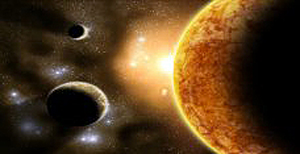
Another book — The Secret of Atlantis, by Otto Muck — points to evidence of the impact of a colossal body with the Earth in the southwest Atlantic as the cause of Atlantis' demise. Fiery debris rained on Atlantis, followed by tidal waves that inundated the island. Muck refers to twin depressions 23,000 ft deep in the sea floor close to Puerto Rico, and to 3,000 shallow, eroded troughs, occupying part of a elliptical area that extends out over the Atlantic. He deduces that these were the result of an asteroid 6 miles (10 kilometers) wide that hit the Earth with an explosive force of 3,000 medium-sized hydrogen bombs, triggering the earthquakes described in Plato's story, and splitting the Atlantic open along the line of the present-day mid-Atlantic Ridge.
| | | | | |
| | |
| |
Furthermore, the Earth's Poles were shifted, and a new geological age abruptly began, with the seasons becoming sharply differentiated for the first time. Siberia, until then having a cool, but not freezing, climate, was suddenly plunged into Artic cold, instantly freezing thousands of mammoths and woolly rhinoceroses, many of them to be found in good condition several millennia later.
| | |






 .
. .
.