Akasha
Also Akasa and Akash. The Sanskrit word meaning "aether," or ether.
In Hinduism and Buddhism, the all-pervasive life principle or space of the universe, a universal medium in which every single thing is contained, touched and surrounded by. It fills all space and interpenetrates all matter.
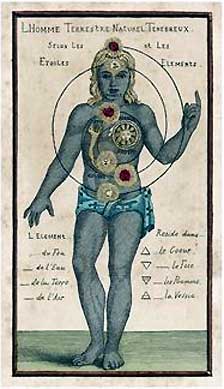
Hindu philosophy interprets the akasha as the ether, or soniferous ether, the fifth and subtlest etheric element that permeates the universe, omnipresent, acting as the agent through which electromagnetic forces operate and from all other principles are created. These five "ethers," or elements, could be likened to the five senses of man. In order to hear distinct sounds, the Hindu theosophist concentrates himself upon akasha.
In Buddhism the akasha is space, both space bounded by the material world, and a form of space which is infinite and indefinable, which contains the material world. The notion was pioneered to the West in the early 20th century by Madame Helena P. Blavatsky, cofounder of the Theosophical Society, who linked the akasha to other interpretations of the universal life force by occultists through the ages, such as the quintessence, that luminous fifth element — invisible to normal sight — which was seen as tying together in union or pact the other four elements. According to Blavatsky the akasha shapes the Anima Mundi and make up the soul and animal spirit of mankind.
In occultism, akasha it is also defined as the "other" of the 'two worlds', the world through which the witch or magician walks through, being related to outer space, inner space, life force and the un-manifest.
An important related term is the so-called Akashic Chronicles — sometimes Akashic Records, or Book of Life — that, according to Theosophy, are the historical records of all world events and personal experiences of all thoughts and actions which have taken place, are taking place and will take place on the earth. These are indelibly imprinted upon the akasha or astral plane and may under ordinary circumstances be read only by adepts or initiates, usually in an altered state of consciousness.
It is also said that these Akashic Archives can be tapped during dreams. Sometimes the information so obtained is remembered consciously only upon awakening. More often, nocturnal perusals of these records are said not to be remembered, although the fruits of such "dream research" may be retrieved in moments of intuition in daily life. Rudolf Steiner, for example, claimed to have consulted the Akashic Records for his descriptions of the mythical lost civilizations of Atlantis and Lemuria. Edgar Cayce, the sleeping prophet, also claimed to have obtained knowledge from the Book of Life.
See Theosophy, Rudolf Steiner, Edgar Cayce, Mystic Gifts and Charms - New Age Gift Shop & Wicca and Pagan Supplies, Love Spells -- Use these powerful love spells to help you find and keep your true love, The Tarot Store, The Chakra Store, Divination & Scrying Tools and Supplies, Unique Amulets, Talismans, Good Luck Charms, and Love Tokens, Powerful Witch Doctor Spell Kits, Powerful Spells - Cast by Andreika the Witch, Webmasters Make $$$, AzureGreen - Celebrating All Paths to the Divine, ISIS - Tools for Your Soul's Journey, and The Pyramid Collection - Myth, Magick, Fantasy and Romance.
Sources: (1) Dictionary of the Occult, Caxton Publishing; (2) Spence, Lewis, An Encyclopedia of Occultism, Carol Publishing Group; (3) Randi, James, An Encyclopedia of Claims, Frauds, and Hoaxes of the Occult and Supernatural, St. Martin's Griffin; (4) Lewis, James R., The Dream Encyclopedia, Visible Ink Press.
| | |







 .
. .
. .
. .
. .
. .
.