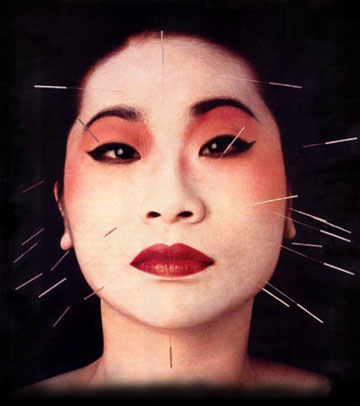
An ancient Oriental system and medical technique that involves inserting and stimulating particular points on the skin with fine needles. It is one of the main forms of treatment in traditional Chinese medicine.
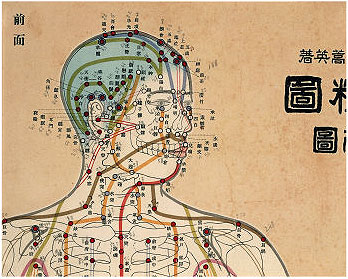
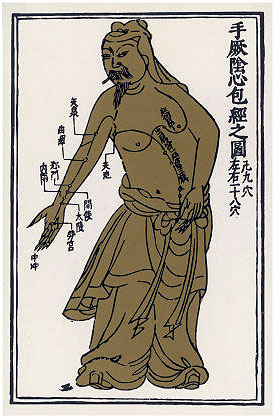
There are more than 360 acupuncture points in the human body. The needles may be twirled, heated, stimulated with weak electrical current, ultrasound and sometimes even wavelengths of light. It is used in the treatment of pain, depression, allergies, asthma, arthritis, bladder and kidney problems, constipation, diarrhea, colds, flu, bronchitis, dizziness, smoking, fatigue, gynecologic disorders, headaches, migraines, paralysis, high blood pressure, PMS, sciatica, sexual dysfunction, stress, stroke, tendinitis, drug addiction, vision problems, and even AIDS.
Acupuncture needles dating from more than 4000 years ago have been found in China. The first needles were stone; later, bronze, gold, or silver were used, and today needles are usually made of steel. Initially, needles were used only to prick boils and ulcers.
Acupuncture was developed in response to the theory that there are special “meridian points” on the body connected to the internal organs and that “vital energy” flows along the meridian lines. According to this theory, diseases are caused by interrupted energy flow, and inserting and twirling needles restores normal flow.
Before the 1970s only a few Western physicians who had been to China were fascinated and intrigued by acupuncture. But when Richard Nixon became the first U.S. president to visit China, this all changed. American journalists covering the president's trip were astonished to observe major operations being performed on patients without any use of anesthetics. In fact, wide-awake patients were being operated on with only acupuncture needles inserted into them to control pain.
Today acupuncture is being practiced by more than 10,000 practitioners in every state of the Union, and millions of Americans have used it as a therapy. Unfortunately it is mainly unsupported by the traditional medical institutions and establishment, and many still think of it as a pseudoscience.
This website is best viewed with the latest
versions of
Microsoft
Internet Explorer or
Firefox.
Occultopedia
makes extensive use of
Flash and Scripting in its pages and interface. Make certain your browser
permissions are set
accordingly and that you have the latest
Flash plug-in for the full experience, proper look and accurate
layout. You can do it with confidence. This site does not contain any viruses, malicious software
or scripts.
Occultopedia is the genuine article, the
original and the best internet index of the extraordinary and uncanny,
shamelessly copied by many, but never equaled. Online since 1995 — at first in a free web space provider
(Tripod.com), and in 1997 finally
with its own domain name and hosting — Occultopedia still is the
principal online resource for those looking for the unexplained, the
curious and the unusual.
Occultopedia respects your privacy. As
such, no cookies or any other tracking software will be installed as a
part of this website's original programming. I do not seek to obtain any personal information
beyond what is volunteered through electronic communications
(e.g. emails & forms).
Occultopedia may appear to be a for profit site, but my site is
not in reality a commercial one. All of the commercial links are from affiliate
programs, and the little revenue I get from these is to pay for hosting,
bandwidth — that can be quite costly if you have a lot of traffic, graphics and
pages — and any other expenses related to Occultopedia's upkeep, support, and maintenance.
For more details, visit my
ordering
information page.
Occultopedia is a
FREE online
resource available to the whole world. Usage of my word definitions and articles
by educational institutions, teachers and students alike, is here by granted.
Reproduction for profit, and for display in another web site is strictly
forbidden, and will be handled as copyright infringement and prosecuted to the
full extent of the law. However, if you follow
some simple guidelines,
I will grant permission for limited reproduction. For more information, please consult my
intellectual property rights, warranties and
disclaimers information page. Support Occultopedia and make it your
online shopping
destination. If you prefer, you can also make a donation.
HELP FOOT THE BILL: this website
is created and maintained by one guy, who also pays the hosting bill.
Please donate if you like and/or use Occultopedia.
Participate in Occultopedia and submit a word
definition or article for the occult encyclopedia at my
entry submission
page. If you would like to suggest a web site or page for
addition into Occultopedia's links database, please go to my
URL submission page.






 .
. .
. .
. .
.