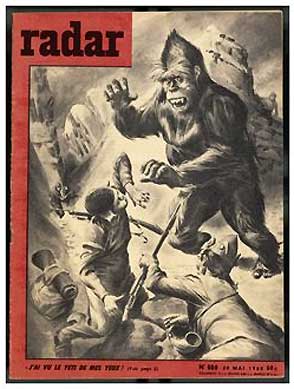
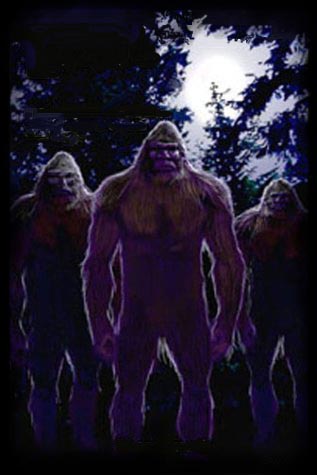
More beast than man apelike creatures that allegedly have been sighted for centuries all over the world, but who's existence has never been convincingly proven. Sightings usually occur in mountainous regions and almost exclusively in those which lie in the forest belts of the Earth.
Supposedly, according to reports and experts, there are three basic sizes of these creatures:
1. A dwarf or pygmy type, usually between 3 and 5 ft tall.
2. A man-sized one, usually between 5 and 8 ft tall.
3. A giant type, usually between 8 and 15 ft tall, believed by some to be surviving Gigantopithecus, the largest primate that ever walked the Earth, which, according to established science, went extinct 500,000 years ago.
These creatures are known by many different names, depending on the continent, country, region, and particular area they are supposedly from.
Dwarf types include the Agogwe(Tanzania), the Alux (South and Central America), the Apamandi (Zaire), the Batutut (Borneo), the Chimanimani (South Africa), the Duende or Tarma (Peru), the Fating'ho (Senegal), the Guayazi(South America), the Higabon (Japan), the Jungli Admi (India), the Kapre (Philippines), the Koolookamba (Gabon), the Maero or Macro (New Zealand), the Mau (East Africa), the Menehune (Hawaii), the Mono Grande or Didi (Guyana), the Nittaewo (Sri Lanka), the Orang-Pendek (Sumatra), the Sehitι (Ivory Coast), the Shiru (Colombia), the Teh-lma (Himalayas), the Tokoloshe (Southern Rhodesia), the Ufiti (Malawi), the Vedi (Croatia), the Vιle (Fiji Islands), the Xipe (Nicaragua).
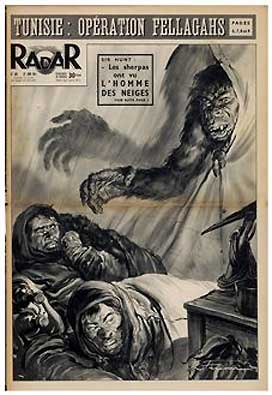
Sherpas guiding a Japanese Everest Expedition are woken by a Yeti peering into their tent . . . — Buy this art print at AllPosters.
Man-sized types include the Aigypan (Venezuela), the Almas (Caucasus), the Arulataq (Alaska), the Barmanu (Pakistan, Afghanistan), the Chemosit (Kenya), the Chuchunaa (Siberia), the Ferla Mohr or Brenin Llwyd (also known as Scotland's Big Grey Man), the Gul-Biavan (Russia, Mongolia), the Grendel (Denmark), the Kaptar (Russia, Mongolia), the Khi-Trau (Laos, Vietnam), the Kikomba (Zaire), the Ksy-Giik (Kazakhstan, Kirghizistan), the Mapinguary (Brazil), the Mawas (Malaysia), the Meh-teh (Himalayas), the Muhalu (West Africa), the Nasnas (Iran), the Nguoi Rung (Vietnam), the Sisemite (Guatemala, Belize), the Tano Giant (West Africa), the Ukumarzupai (Argentina, Chile), the Ucumar or Ucu (Chile), the Vasitri (Venezuela), the Wa'ab (Sudan), the Windigo (Quebec), the Wudewasa or Tree Eater (Finland, Croatia), the Yowie (Australia).
All of these size types in turn also present some variation as for length and color of hair and some other characteristics, such as feet shape, facial features, limbs length, posture, behavior and diet. All of these characteristics further split those size types into men-like (Hominids), ape-like (Pongids), bear-like (Ursidaes) and monkey-like (Simioids) creatures. Most of the reports are of creatures described as Hominoids (Hominids and Pongids), with very few Simioids and Ursidaes descriptions.
This website is best viewed with the latest
versions of
Microsoft
Internet Explorer or
Firefox.
Occultopedia
makes extensive use of
Flash and Scripting in its pages and interface. Make certain your browser
permissions are set
accordingly and that you have the latest
Flash plug-in for the full experience, proper look and accurate
layout. You can do it with confidence. This site does not contain any viruses, malicious software
or scripts.
Occultopedia is the genuine article, the
original and the best internet index of the extraordinary and uncanny,
shamelessly copied by many, but never equaled. Online since 1995 — at first in a free web space provider
(Tripod.com), and in 1997 finally
with its own domain name and hosting — Occultopedia still is the
principal online resource for those looking for the unexplained, the
curious and the unusual.
Occultopedia respects your privacy. As
such, no cookies or any other tracking software will be installed as a
part of this website's original programming. I do not seek to obtain any personal information
beyond what is volunteered through electronic communications
(e.g. emails & forms).
Occultopedia may appear to be a for profit site, but my site is
not in reality a commercial one. All of the commercial links are from affiliate
programs, and the little revenue I get from these is to pay for hosting,
bandwidth — that can be quite costly if you have a lot of traffic, graphics and
pages — and any other expenses related to Occultopedia's upkeep, support, and maintenance.
For more details, visit my
ordering
information page.
Occultopedia is a
FREE online
resource available to the whole world. Usage of my word definitions and articles
by educational institutions, teachers and students alike, is here by granted.
Reproduction for profit, and for display in another web site is strictly
forbidden, and will be handled as copyright infringement and prosecuted to the
full extent of the law. However, if you follow
some simple guidelines,
I will grant permission for limited reproduction. For more information, please consult my
intellectual property rights, warranties and
disclaimers information page. Support Occultopedia and make it your
online shopping
destination. If you prefer, you can also make a donation.
HELP FOOT THE BILL: this website
is created and maintained by one guy, who also pays the hosting bill.
Please donate if you like and/or use Occultopedia.
Participate in Occultopedia and submit a word
definition or article for the occult encyclopedia at my
entry submission
page. If you would like to suggest a web site or page for
addition into Occultopedia's links database, please go to my
URL submission page.






 .
. .
.