A large creature, not human but walking upright, allegedly living in the mountains of Tibet. The term 'Abominable Snowman' was accidentally coined by a 'Calcutta Statesman's columnist named Henry Newman, who at the time (1921) was writing an article about Howard-Bury's sighting of a group of these beasts.
The term Abominable Snowman became a popular name for this type of creature, being used by journalists throughout the years to refer to any unknown Asian hominid.
"It was a creature not much taller than a man, but broader in the shoulders, and covered with heavy white hair. It walked upright, but lurched forward in all, a most terrifying sight." (Anonymous quote describing the Abominable Snowman).
Also known as Yeti, Raksha (Sanskrit word for 'demon'), Metoh-Kangmi, Yeh-teh,and Meh-teh, this unsubstantiated creature is said to be 7 to 10 feet tall, with feet twice the size of a human's, and with a noticeably disagreeable aroma. Similar beings have been also reported in Nepal, China, Siberia, Canada, and the U.S. Northwest.
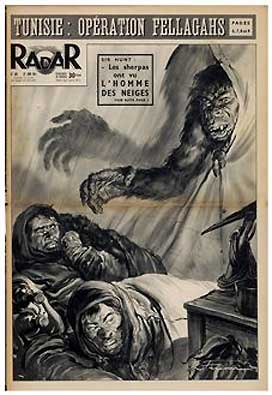
Sherpas guiding a Japanese Everest Expedition are woken by a Yeti peering into their tent . . . — Buy this art print at AllPosters.
Contrary to popular belief, the Snowman is not white, instead having dark fur, and is not a single creature.
If real, these man-animals probably live in quiet refuge in the foggy valleys of the Himalayan regions, using the snowy passes only to move from one area to another.
In every mountain range in the world live people who tell stories of a strange, lumbering, manlike creature; of footprints too large to belong to any human; of isolated communities living in fear of a monster that goes by many names.
In the Himalayas he is known as the Yeti. Elsewhere in Asia, from the Gobi Desert in the north to Assam in the south, he goes by the names of Meti, Shookpa, Migo, Kang-Mi, and many others. To people living in remote, wooded parts of the northwestern United States, he is Bigfoot. In the foothills of the Canadian Rockies he is known as the Sasquatch.
Whatever the name, the description is roughly the same; height, up to 10 feet; weight, about 300 pounds; appearance, hairy and apelike, but walks upright on two legs; species, unknown.
Living in impenetrable woods appears to be a characteristic of these creatures everywhere they are sighted, thus supporting the theory that they are evolutionary dropouts seeking refuge from an inimical world.
The late Ivan T. Sanderson — world famous zoologist and writer who published exhaustively in scientific journals under the auspices of the British Museum, the Chicago Museum of Natural History and other institutions, holding degrees with honors from Cambridge University, in Botany, Zoology, and Geology (he also studied Anatomy and Physical Anthropology) — accumulated material for over 30 years on the subject of mysterious man-beasts. According to his research and work, not one, but possibly four separate kinds of Yeti still walk the earth!
This website is best viewed with the latest
versions of
Microsoft
Internet Explorer or
Firefox.
Occultopedia
makes extensive use of
Flash and Scripting in its pages and interface. Make certain your browser
permissions are set
accordingly and that you have the latest
Flash plug-in for the full experience, proper look and accurate
layout. You can do it with confidence. This site does not contain any viruses, malicious software
or scripts.
Occultopedia is the genuine article, the
original and the best internet index of the extraordinary and uncanny,
shamelessly copied by many, but never equaled. Online since 1995 — at first in a free web space provider
(Tripod.com), and in 1997 finally
with its own domain name and hosting — Occultopedia still is the
principal online resource for those looking for the unexplained, the
curious and the unusual.
Occultopedia respects your privacy. As
such, no cookies or any other tracking software will be installed as a
part of this website's original programming. I do not seek to obtain any personal information
beyond what is volunteered through electronic communications
(e.g. emails & forms).
Occultopedia may appear to be a for profit site, but my site is
not in reality a commercial one. All of the commercial links are from affiliate
programs, and the little revenue I get from these is to pay for hosting,
bandwidth — that can be quite costly if you have a lot of traffic, graphics and
pages — and any other expenses related to Occultopedia's upkeep, support, and maintenance.
For more details, visit my
ordering
information page.
Occultopedia is a
FREE online
resource available to the whole world. Usage of my word definitions and articles
by educational institutions, teachers and students alike, is here by granted.
Reproduction for profit, and for display in another web site is strictly
forbidden, and will be handled as copyright infringement and prosecuted to the
full extent of the law. However, if you follow
some simple guidelines,
I will grant permission for limited reproduction. For more information, please consult my
intellectual property rights, warranties and
disclaimers information page. Support Occultopedia and make it your
online shopping
destination. If you prefer, you can also make a donation.
HELP FOOT THE BILL: this website
is created and maintained by one guy, who also pays the hosting bill.
Please donate if you like and/or use Occultopedia.
Participate in Occultopedia and submit a word
definition or article for the occult encyclopedia at my
entry submission
page. If you would like to suggest a web site or page for
addition into Occultopedia's links database, please go to my
URL submission page.


 ' was accidentally coined by a '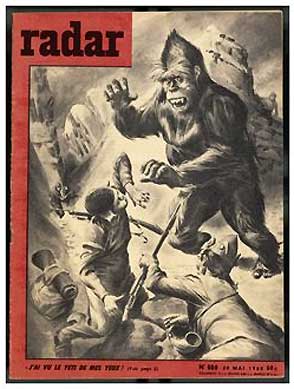




 .
. .
.





 Change Your Life!