The Macumba religion is practiced by a large number of Brazilians, and involves the apparent possession of worshippers by their gods; in a process that in some respects resembles that of Voodoo ceremonies.
There is an initiation ceremony before anyone can become a member of one of the numerous Macumba cults. The initiate having gone into a trance, the priest must decide which god has taken possession, in order to prescribe the appropriate ceremony. This involves animal sacrifice after which blood is smeared on the initiate; during deep trance, suggestions are made for changes in behavior and for obedience to the cult.
During worship, drumming and dancing encourage worshippers to go into trance-states in which their faces often violently change expression, and they sometimes become totally exhausted. On coming out of their trance, they usually know nothing of what has happened during the ceremony, but their behavior is often changed.
Shamanism has always been a major feature of the supernatural in Brazil. A Brazilian shaman is a man, or sometimes a woman, who while in a trance can talk to spirits and with their help see into the future, cure illness, and diagnose diseases before a conventional doctor can do so.
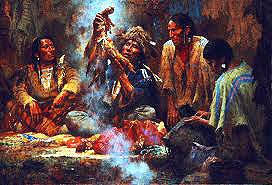
Shamanism in Brazil is often hereditary. However, sometimes the power is suddenly recognized in a person, and a local shaman will undertake to train such a man to recognize his own individual spirit — usually a bird or animal — and to open himself to it so that he can be possessed. The most prestigious spirit of Brazilian shaman is that of the jaguar. The shaman uses certain tools — a ground rattle or a maraca — to gain the spirit's attention, and takes drugs to help him into a trance-state. The trance-states are like theatrical performances, usually seen by firelight and at night. To cure an illness, the shaman will blow tobacco smoke on the part of the body affected, and then apparently suck out the illness.
Brazilian Indians are careful of their souls — and with reason, for these are often stolen away. A shaman is sometimes hired to search for the missing souls of relatives, and to see that they are returned to their bodies. A soul can fly from its body at the sight of a ghost, or on an encounter with the Tupi Anyang, a terrifying spirit with long hair and a boneless body which engages in erotic activity. The Tupi shaman was often as important as the chief of a tribe: some powerful shaman persuaded whole tribes to follow them from one part of the country to another — often in search of the land of Maira, a sort of Mexican Eldorado. At the end of the journey they would build a house and dance in it day or night without sleep or food, in the conviction that it would eventually rise into the sky and endow the dancers with magical properties.
After death, most shamans turn into jaguar spirits; so they are usually buried as far from the tribe as convenient, thorn bushes planted around the grave to keep their ghosts from haunting.
Spiritual warrior school for Aztec- Mexica children is called a Telpochcalli. This is where Aztec children would start their training.
This website is best viewed with the latest
versions of
Microsoft
Internet Explorer or
Firefox.
Occultopedia
makes extensive use of
Flash and Scripting in its pages and interface. Make certain your browser
permissions are set
accordingly and that you have the latest
Flash plug-in for the full experience, proper look and accurate
layout. You can do it with confidence. This site does not contain any viruses, malicious software
or scripts.
Occultopedia is the genuine article, the
original and the best internet index of the extraordinary and uncanny,
shamelessly copied by many, but never equaled. Online since 1995 — at first in a free web space provider
(Tripod.com), and in 1997 finally
with its own domain name and hosting — Occultopedia still is the
principal online resource for those looking for the unexplained, the
curious and the unusual.
Occultopedia respects your privacy. As
such, no cookies or any other tracking software will be installed as a
part of this website's original programming. I do not seek to obtain any personal information
beyond what is volunteered through electronic communications
(e.g. emails & forms).
Occultopedia may appear to be a for profit site, but my site is
not in reality a commercial one. All of the commercial links are from affiliate
programs, and the little revenue I get from these is to pay for hosting,
bandwidth — that can be quite costly if you have a lot of traffic, graphics and
pages — and any other expenses related to Occultopedia's upkeep, support, and maintenance.
For more details, visit my
ordering
information page.
Occultopedia is a
FREE online
resource available to the whole world. Usage of my word definitions and articles
by educational institutions, teachers and students alike, is here by granted.
Reproduction for profit, and for display in another web site is strictly
forbidden, and will be handled as copyright infringement and prosecuted to the
full extent of the law. However, if you follow
some simple guidelines,
I will grant permission for limited reproduction. For more information, please consult my
intellectual property rights, warranties and
disclaimers information page. Support Occultopedia and make it your
online shopping
destination. If you prefer, you can also make a donation.
HELP FOOT THE BILL: this website
is created and maintained by one guy, who also pays the hosting bill.
Please donate if you like and/or use Occultopedia.
Participate in Occultopedia and submit a word
definition or article for the occult encyclopedia at my
entry submission
page. If you would like to suggest a web site or page for
addition into Occultopedia's links database, please go to my
URL submission page.












 .
. .
.
 .
.