Haunting
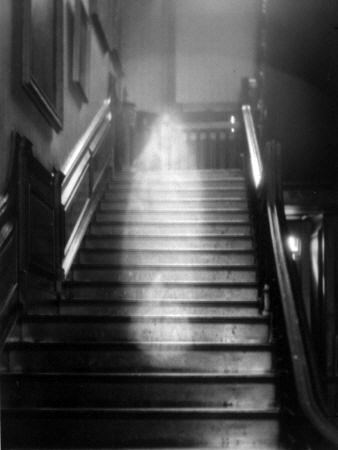
Mysterious happenings attributed to the presence of ghosts or spirits. Phenomena include apparitions, noises, smells, tactile sensations, extremes in temperature, movement of objects, and the like.
The inexplicable supernatural manifestation — appearance, sound or feel — of people, animals, objects or spirits, which does not inhabit the usual three dimensions or conform to reality as it is usually understood.
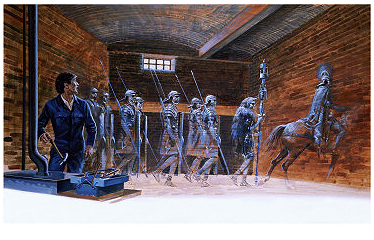
Despite much scientific inquiry since the late 19th century, very little is known about the nature of hauntings and why they happen. The term 'haunt' is derived from the same root as 'home', and refers to the occupation of homes by the spirits of deceased people and animals who lived there. Other haunted sites seem to be places merely frequented or liked by the deceased, or places where violent death has occurred. The replaying of a former event, which is called 'place memory', is also a type of haunting.. Many studies of such phenomena have been done in modern times, but conclusive proof of the existence of apparitions and ghosts remains elusive.
 | | | | |
| | | |
| |
By their nature, hauntings are difficult to define. Most hauntings have no clear reason or purpose. Some are continual and others are active only on certain dates that correspond to the deaths or major events in the lives of the deceased. Some hauntings are brief, lasting only a few weeks, months, or years, while others continue for centuries. Haunted places often are pervaded by an oppressive atmosphere. Reported experiences usually involve strange smells, extreme cold and the displacement of objects.
Not everyone who goes to a haunted place experiences paranormal phenomena. The theory is that only individuals with certain psychic attunements or emotional states are receptive. Few hauntings involve seeing apparitions. In those that do, a ghost may be seen by a single individual or collectively by several people present at the same time. Other types of hauntings include the replaying of former events (part of the apparition kind), the movement of objects, strange sounds and noises, and spooky atmospheres.
Thousands of hauntings have been investigated by psychical researchers and parapsychologists over the last hundred years or so. Numerous theories have been advanced, all inconclusive. Some early psychic researchers thought that ghosts were meaningless fragments of energy left behind in death. Others have theorized that hauntings are a form of psychometry, vibrations of events and emotions imbued into a house, site, or object.
One popular spiritualist theory holds that hauntings occur when the spirit of the dead person or animal is trapped on the earth plane for various reasons, doesn't know it is dead, or is reluctant to leave. Gentle exorcisms will send the spirit on to the after-world.
Researchers employ three basic techniques to investigate a haunting:
1. Description - involves taking eyewitness accounts.
2. Experimentation - involves bringing a psychic to the site to corroborate the eyewitness accounts or provide new information.
3. Detection - involves the observation or recording of phenomena using a ghost-hunter's kit, including camcorders, infrared cameras and tape recorders, as well as heat sensors and Geiger counters to measure changes in the atmosphere.
Such methods are at best imprecise and interpretation of results is often subjective. Critics say ghost investigation is imprecise and not a true science because it is heavily reliant upon eyewitness testimony.
See Ghost, Altered State of Consciousness, ESP, Seance, Materialization, Asport, Automatic Writing, Findhorn, Glastonbury Scripts, Theosophy, Poltergeist, Psychic Archaeology, Spiritualism, British Society for Psychical Research, Mystic Gifts and Charms - New Age Gift Shop & Wicca and Pagan Supplies, Love Spells -- Use these powerful love spells to help you find and keep your true love, The Tarot Store, Divination & Scrying Tools and Supplies, Unique Amulets, Talismans, Good Luck Charms, and Love Tokens, Powerful Witch Doctor Spell Kits, Powerful Spells - Cast by Andreika the Witch, Webmasters Make $$$, AzureGreen - Celebrating All Paths to the Divine, ISIS - Tools for Your Soul's Journey, and The Pyramid Collection - Myth, Magick, Fantasy and Romance.
Sources: (1) Allen, Judy, Unexplained: An Encyclopedia of Curious Phenomena, Strange Superstitions, and Ancient Mysteries, Kingfisher Publishers; (2) Spence, Lewis, An Encyclopedia of Occultism, Carol Publishing Group; (3) Dictionary of the Occult, Caxton Publishing.
| | |





 .
. .
.