Anthropomancy
Alternatively named Splanchomancy, Spamastomancy, Anthromancy, Anthropomancia, Anthropomancie, Anthropomantia, Anthropomanzia, Anthroposcopia, Anthroposcopy, and Antinopomancy.
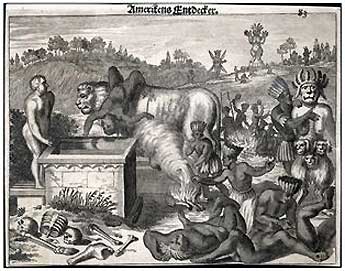
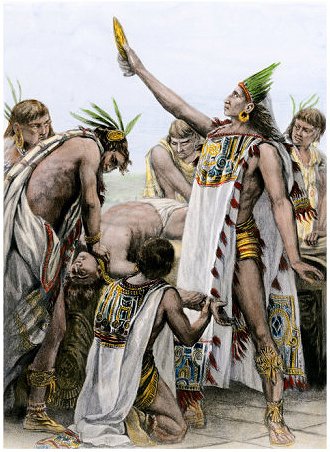
Derived from the Greek anthropos ('man') and manteia ('divination'), this is a gruesome method of divination, by means of interpreting the entrails, particularly the intestines, of dead or dying men, women or children, through sacrifice.
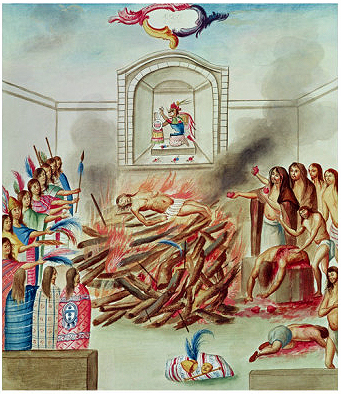
Variants of this method of divination included taking omens from the interpretation of the victims death-spasms, desperate screams, by the way they fell, bled or burned, and by how long they took to die.
This horrible and barbaric procedure of divination is extremely ancient, and is believed to have originated in the Neolithic era. Many times this practice involved tearing open the body of a live human being to proceed with an examination of the entrails at work, and by its movements and sounds, and sometimes by the color of the unfortunate victim organs, accordingly determine the future or the truth.
If the victim approached the altar reluctantly, or eluded the stroke of the axe, or did not bleed freely, if the entrails were decayed or defective, if the heart was small, the gods were thought to be unpropitious. If otherwise, the omens were good.
In burning sacrifices, if the fire was kindled easily and burned clearly, and if the flame immediately consumed the victim, the sacrifice was thought to be adequate.
One of the specialized forms of this type of divination was Antinopomancy, which was by the exclusive sacrifice of children. Another specialized form, Splanchomancy, consisted of divination by the entrails of women, especially young virgins. The Sumerians, the Babylonians, the Japanese, the Celts, the Comanche Indians, the Incas, the Aztecs, the Egyptians, the Scythians, and the Greek, amongst others, all practiced Anthropomancy at one time or another.
The Romans were addicted to Anthropomancy. This horrific type of divination involving human sacrifice and the dissection of bodies continued intermittently through the period of the Roman Empire and was probably revived by notorious practitioners of black arts during the Middle Ages.
|
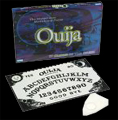
Ouija Board: Glow-in-the-Dark
The famous Ouija
board it's been consulted for many years. How it works is still a mystery! Ask any questions you want. Ouija will answer. Glow-in-the-dark makes this game a must-have for sleep overs!

|
| |
Heliogabalus — the Roman emperor Varius Avitus Bassanius, 205-221 AD, also known as Elagabalus, killed with his mother by the Praetorian guard for deviant and perverse practices — was one of the known practitioners of this type of divination. He was said to have been particularly fond of it, and to have performed this method of prediction on a regular basis.
It is said that the ancient Scyths sacrificed all the strangers that came into their hands to their goddess Diana, and that Anthropomantic proceedings were always part of these ritualistic killings. King Saul, the Biblical figure, is also said to have been a practitioner of Anthropomancy.
In the most common method of Anthropomancy victims viscera — organs of the digestive, respiratory, urogenital, as well as the spleen, the heart, and great vessels — were used to read symbols of the future.
Another type of Anthropomancy involved throwing victims from a high rock into the sea, or from a high bridge into a river, and prophetically interpret their cries, the manner in which they fell, and which part of their bodies hit water first. Sometimes victims were thrown down volcanoes, precipices, and even high towers, so that their screams could be prophetically studied as they fell, and their entrails and brains observed after being splattered on impact.
Julian the Apostate (Flavius Claudius Julianus, 332-363 AD, another Roman emperor, nephew of Constantine the Great), in his pursuit of magical knowledge and operations, also caused a large number of children to be slowly sacrificed in moonlit rituals, so that he might consult and interpret the movements in their entrails. During his last experiment at Carra, Mesopotamia, he enclosed himself within the Temple of the Moon. Unexpectedly being called upon to combat the Persians, he sealed the temple's doors, and placed a guard at its entrance. But Julian did not survive the fight, dying in battle. When the temple was reopened by his successor's men, they discovered a woman inside, hanging by her hair with her liver torn out.
Herodotus wrote that Menelaus, king of Sparta, also practiced Anthropomancy. The story goes that, when detained in Egypt because of contrary winds, Menelaus sacrificed two local country children, in order to discover his destiny.
| | |









 .
. .
. .
. .
. .
. .
.