Mysteries
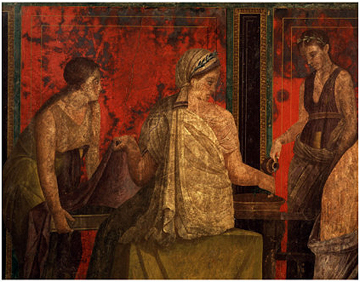
Secret pagan religious cults that flourished during the Hellenistic period, involving adoration of various deities and rites of spiritual transformation and rebirth.
In a broader sense, the term 'mysteries' also is applied to esoteric teachings and the rites of secret societies outside of the classical world. 'Mystery' derives from the Greek myein, ‘to close', and refers to the closing of the lips or the eyes. The mystes, or initiate, was required to keep the secrets of the cult. The content of the rites remains a secret, but the large numbers who underwent the initiation, often lasting several days, were promised eternal life in the after-world, through rebirth or redemption. These initiations consisted of cleansing rites, fasting, and the consecration itself. Sometimes they were accompanied by orgiastic rites, such as wild dances, self-mutilation, or castration like the priests in the cult of Cybele. The sacral meal is often also a part of the initiation.
The Eleusinian mysteries, the most popular and influential of the Greek cults, centered on the worship of Persephone and her mother, Demeter, the grain goddess. The rites were intimately linked to the cycle of fertility of the Earth.
The Dionysian mysteries, the second most important Hellenistic cult, centered on Dionysus (Bacchus), the Thracian bull-god and ruler of the dead and souls, who became the god of the vine and vegetation. Immortality could be obtained through communion with him in ecstatic rites apparently involving consumption of wine and the raw flesh of a sacrificed animal, and sex.
In the mysteries of Isis and Osiris, the Egyptians observed a mystery play of succession, the death of a pharaoh and the succession of another, with a funeral ritual of mummification and burial in which the dead would be mystically joined in the underworld by Osiris.
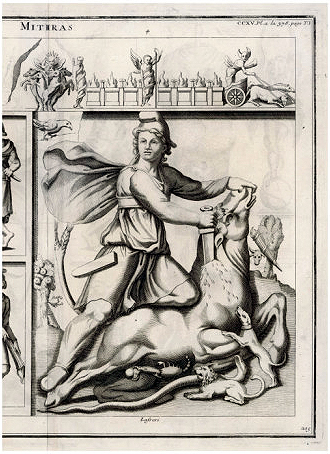
The Mithraic mysteries were a male cult of Persian origin centered on the slaying of a bull by Mithra, god of light and beneficence, which guaranteed the fruitfulness of the earth. The initiates consumed bread and water, representing the body and blood of the divine bull. Initiates were believed to be under the divine protection of Mithra, who would protect their souls from darkness.
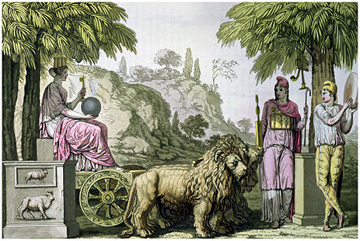
Other well-known examples are the mystery cults of Cybele and Attis (Phrygia).
There were also Judaic and Christian mysteries. Rites of circumcision, baptism, and anointing the forehead with oil may be seen to have similarities with the ancient mystery rites of initiation into a select religious community. The Jewish holy meal of Seder reenacts a religious drama, the Exodus from Egypt.
The primary Christian mysteries are the Eucharist, the Cross, and the baptism. The rite of the Eucharist involves the consumption of bread and wine as the body and blood of Christ, a means of seeking salvation through union with Christ. Goddess or Great Mother remains a hidden part of these rites, as the cup which holds the blood and wine, and the womb in which the rebirth of baptism takes place. The Cross represents the scheme of the universe, the entire history of the cosmos before and after the crucifixion of Christ; it foreshadows the coming of the transfigured Christ. The baptism, the fundamental mystery, represents initiation into the divine life of the resurrected Christ.
The elements and purpose of the ancient mysteries — resurrection to eternal life — have been preserved in the rites of various secret societies such as the Freemasons and Rosicrucians.
See Awakening Mystical Consciousness, The Tao of Physics: An Exploration of the Parallels Between Modern Physics and Eastern Mysticism, The Tantric Mysticism of Tibet: A Practical Guide, Wisdom of the Mystic Masters, Buddhism, Christ, Freemasonry, Thoth, Mithra, Rosicrucians, Taoism, Mystic Gifts and Charms - New Age Gift Shop & Wicca and Pagan Supplies, Love Spells -- Use these powerful love spells to help you find and keep your true love, The Tarot Store, Divination & Scrying Tools and Supplies, Unique Amulets, Talismans, Good Luck Charms, and Love Tokens, Powerful Witch Doctor Spell Kits, Powerful Spells - Cast by Andreika the Witch, Webmasters Make $$$, AzureGreen - Celebrating All Paths to the Divine, ISIS - Tools for Your Soul's Journey, and The Pyramid Collection - Myth, Magick, Fantasy and Romance.
Sources: (1) Dictionary of the Occult, Caxton Publishing; (2) Spence, Lewis, An Encyclopedia of Occultism, Carol Publishing Group; (3) Randi, James, An Encyclopedia of Claims, Frauds, and Hoaxes of the Occult and Supernatural, St. Martin's Griffin; (4) The Encyclopaedia Britannica Eleventh Edition Handy Volume Edition, Oxford University Press.
| | |







 .
. .
. .
.