| |
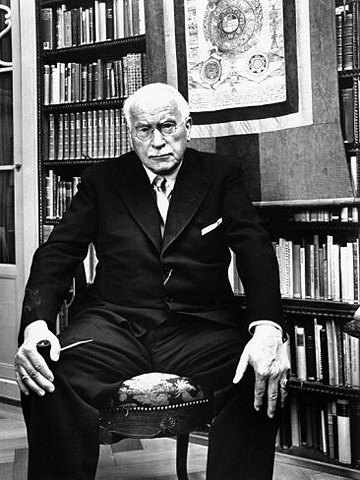
Jung, Carl Gustav (1875-1961)
Swiss psychiatrist, who founded the analytical school of
psychology. Jung broadened Sigmund Freud's psychoanalytical approach,
interpreting mental and emotional disturbances as an attempt to find
personal and spiritual wholeness.
Born on July 26, 1875, in Kesswil,
Switzerland, the son of a Protestant clergyman, Jung developed during his lonely childhood
an inclination for dreaming and fantasy that greatly influenced his adult work. After
graduating in medicine in 1902 from the universities of Basel and Zürich, with a wide
background in biology, zoology, paleontology, and archaeology, he began his work on word
association, in which a patient's responses to stimulus words revealed what Jung called
complexes a term that has since become universal. These studies brought
him international renown and led him to a close collaboration with Freud. With the
publication of Psychology of the Unconscious (1912; trans. 1916), however, Jung declared
his independence from Freud's narrowly sexual interpretation of the libido by showing the
close parallels between ancient myths and psychotic fantasies and by explaining human
motivation in terms of a larger creative energy. He gave up the presidency of the
International Psychoanalytic Society and cofounded a movement called analytical
psychology.
During his remaining 50 years Jung
developed his theories, drawing on a wide knowledge of mythology and history; travels to
diverse cultures in New Mexico, India, and Kenya; and especially the dreams and fantasies
of his childhood. In 1921 he published a major work,
Psychological Types
(trans. 1923), in which he dealt with the relationship between the conscious and
unconscious and proposed the now well-known personality types, extrovert and introvert. He
later made a distinction between the personal unconscious, or the repressed feelings and
thoughts developed during an individual's life, and the collective unconscious, or those
inherited feelings, thoughts, and memories shared by all humanity. The collective
unconscious, according to Jung, is made up of what he called archetypes, or
primordial images. These correspond to such experiences as confronting death or choosing a
mate and manifest themselves symbolically in religions, myths, fairy tales, and fantasies.
Jung's therapeutic approach aimed at
reconciling the diverse states of personality, which he saw divided not only into the
opposites of introvert and extrovert, but also into those of sensing and intuiting, and of
feeling and thinking. By understanding how the personal unconscious integrates with the
collective unconscious, Jung theorized, a patient can achieve a state of individuation, or
wholeness of self.
Jung wrote voluminously, especially on
analytical methods and the relationships between psychotherapy and religious belief. He
died on June 6, 1961, in Küsnacht.
Related audio
cassettes:
Man and His
Symbols : Approaching the Unconscious.
Memories, Dreams,
Reflections.
Related
books:
Aion: Researches
into the Phenomonology of the Self.
Aion: Researches
into the Phenomenology of Self (Part 2).
Alchemical
Studies.
A Most Dangerous
Method: The Story of Jung, Freud, and Sabina Spielrein.
Analytical
Psychology-Its Theory and Practice: The Tavistock Lectures, 1935.
Answer to Job.
Archetypes and
the Collective Unconscious.
Aspects of the
Feminine.
A Strategy for a
Loss of Faith: Jung's Proposal (Studies in Jungian Psychology by Jungian Analysts, No 56).
C.G. Jung: His
Friendships With Mary Mellon and J. Bl Priestley.
C.G. Jung:
Letters 1906-1950.
C.G. Jung:
Letters, 1951-1961.
C.G. Jung:
Psychological Reflections; A New Anthology of His Writings, 1905-1961.
C.G. Jung: Word
and Image.
C.G. Jung and
Literary Theory: The Challenge from Fiction.
C.G. Jung and the
Humanities: Toward a Hermeneutics of Culture.
C.G. Jung
Speaking: Interviews and Encounters.
Carl Gustav Jung.
Complex/Archetype/Symbol
in the Psychology of C. G. Jung.
Creative Aging:
Discovering the Unexpected Joys of Later Life Through Personality Type.
Cult Fictions: C.G. Jung and the Founding of Analytical Psychology.
Development of
Personality.
Discovering Your
Self Through the Tarot: A Jungian Guide to Archetypes & Personality.
Dream Analysis:
Notes of the Seminar Given in 1928-1930 by C.G. Jung.
Dream Theatres of
the Soul: Empowering the Feminine Through Jungian Dream Work.
Dreams.
Encountering Jung
on Mythology (Encountering Jung).
Flying Saucers:
A Modern Myth of Things Seen in the Skies.
Four Archetypes
(Collected Works of C.G. Jung).
Food and
Transformation: Imagery and Symbolism of Eating (Studies in Jungian Psychology by Jungian
Analysts, No 74).
Freud and
Psychoanalysis.
Freud or Jung.
From Image to
Likeness: A Jungian Path in the Gospel Journey.
General
Bibliography of C.G. Jung's Writings.
Hypnosis: A
Jungian Perspective (Guilford Clinical and Experimental Hypnosis Series).
In God's Shadow:
The Collaboration of Victor White and C.G. Jung (Jung and Spirituality).
In Midlife: A
Jungian Perspective.
Inscapes of the
Child's World: Jungian Counseling in Schools and Clinics.
Insearch:
Psychology and Religion (The Jungian Classics Series ; 2).
Introducing Jung
(Introducing).
Introduction to
Zen Buddhism.
Jesus' Parables:
Finding Our God Within (Jung and Spirituality).
Jung.
Jung and
Christianity in Dialogue: Faith, Feminism, and Hermeneutics.
Jung and Eastern
Thought.
Jung and Reich:
The Body As Shadow.
Jung and
Shamanism in Dialogue: Retrieving the Soul/Retrieving the Sacred (Jung and Spirituality).
Jung and Tarot:
An Archetypal Journey.
Jung and the
Interpretation of the Bible.
Jung and the Lost
Gospels: Insights into the Dead Sea Scrolls and the Nag Hammadi Library.
Jung and the
Monotheisms: Judaism, Christianity and Islam.
Jung and the
Post-Jungians.
Jung for
Beginners (Writers and Readers Documentary Comic Book).
Jung in Contexts: A Reader.
Jung Lexicon: A
Primer of Terms and Concepts (Studies in Jungian Psychology by Jungian Analysts, No 47).
Jung to Live by.
Jung's
Function-Attitudes Explained.
Jung's Map of the
Soul: An Introduction.
Jungian Analysis
(The Reality of the Psyche Series).
Jungian Literary
Criticism.
Jungian Symbolism
in Astrology.
Jungian
Synchronicity in the Astrological Signs and Ages.
Jung's Self
Psychology: A Constructivist Perspective.
Jung's Struggle
With Freud.
Man and His
Symbols.
Meetings With
Jung: Conversations Recorded During the Years, 1946-1961.
Memories, Dreams,
Reflections.
Mirrors of
Transformation: The Self in Relationships : Essays (The Paja Papers).
Modern Man in
Search of a Soul.
Modern Woman in
Search of Soul: A Jungian Guide to the Visible and Invisible Worlds.
Mysterium
Coniunctionis: An Inquiry into the Separation and Synthesis of Psychic Opposites in
Alchemy.
On Divination and
Synchronicity: The Psychology of Meaningful Chance. Originally Presented As Lectures at
the C.G. Jung Institute, Zurich.
On Jung.
Portable Jung.
Practical Jung:
Nuts and Bolts of Jungian Psychotherapy.
Practicing
Wholeness: Analytical Psychology and Jungian Thought.
Primer of Jungian
Psychology.
Psyche and Symbol: A Selection from the Writings of C.G.Jung.
Psychogenesis of
Mental Disease: The Collected Works of C. G. Jung.
Psychological
Types.
Psychology and
Alchemy (Collected Works of Carl C Jung, Vol 12).
Psychology and
Religion (Terry Lectures, 1937).
Psychology and
the East.
Psychology and
the Occult.
Psychology and
Western Religion.
Psychology of
C.G. Jung: An Introduction With Illustrations.
Psychopathology:
Contemporary Jungian Perspectives.
Scapegoat Complex: Toward a Mythology of Shadow and Guilt (Studies in Jugian Psychology by Jungian
Analysts).
Self and
Liberation: The Jung-Buddhism Dialogue (Jung and Spirituality Series).
Spiritual
Pilgrims: Carl Jung and Teresa of Avila.
Symbols of
Transformation.
Synchronicity.
Synchronicity; An
Acausal Connecting Principle.
Tabooed Jung:
Marginality As Power.
Tarot As a Way of
Life: A Jungian Approach to the Tarot.
The Aion Lectures: Exploring the Self in C.G. Jung's Aion.
The Basic
Writings of C.G. Jung (Bollingen Series).
The Basic
Writings of C. G. Jung (The Modern Library).
The Cambridge
Companion to Jung.
The Collected
Works of C. G. Jung, No. 1: Psychiatric Studies.
The Collected
Works of C. G. Jung, No. 4: Freud and Psychoanalysis.
The Collected
Works of C. G. Jung, No. 5: Symbols of Transformation.
The Collected
Works of C. G. Jung, No. 7: Two Essays on Analytical Psychology.
The Collected
Works of C. G. Jung, No. 9: The Archetypes and the Collective Unconscious.
The Collected
Works of C. G. Jung, No. 12: Psychology and Alchemy.
The Collected
Works of C. G. Jung, No. 13: Alchemical Studies.
The Collected
Works of C. G. Jung, No. 14: Mysterium Coniunctionis.
The Collected
Works of C. G. Jung, No. 15: The Spirit in Man, Art and Literature.
The Collected
Works of C. G. Jung, No. 16: The Practice of Psychotherapy.
The Collected
Works of C. G. Jung, No. 18: The Symbolic Life.
The Dynamics of
Symbols: Fundamentals of Jungian Psychotherapy.
The Essential
Jung.
The Father
Contemporary Jungian Perspectives.
The Freud/Jung
Letters: The Correspondence Between Sigmund Freud and C.G. Jung.
The Gnostic Jung
and the Seven Sermons to the Dead.
The Jung Cult:
Origins of a Charismatic Movement.
The Myth of
Meaning in the Work of C.G. Jung.
The
Not-Yet-Transformed God: Depth Psychology and the Individual Religious Experience (Jung
on the Hudson Book Series).
The Psychology of
Kundalini Yoga: Notes of the Seminar Given in 1932 by C.G. Jung (Bollingen Series, No 99).
The Psychology of
the Transference.
The Psychology of
the Unconscious: A Study of the Transformations and Symbolisms of the Libido.
The Survival
Papers: Anatomy of a Midlife Crisis (Studies in Jungian Psychology by Jungian Analysts,
No 35).
The Undiscovered
Self.
The Undiscovered
Self: With Symbols and the Interpretation of Dreams (Bollingen Series ; 20).
The Unfolding God
of Jung and Milton (Studies in the English Renaissance).
Two Essays on
Analytical Psychology.
Visions: Notes
of the Seminar Given in 1930-1934 by C.G. Jung.
The Web of the
Universe: Jung, the 'New Physics,' and Human Spirituality (Jung and Spirituality Series).
What Is Wrong
With Jung.
The Wounded Jung: Effects of Jung's Relationships on His Life and Work (Psychosocial Issues).
Young Carl Jung.
The Zofingia
Lectures: The Collected Works of C.G. Jung.
Further info:
Carl Gustav Jung: The Jung Index.
JungWeb.
| |