Joan of Arc (1412 - 1431)
Also Jeanne D'Arc or Jeanne la Pucelle (virgin).
French national heroine, also known as the Maid of Orléans, who alleged heard saints' voices urging her to help the Dauphin, Charles VII, to regain the throne of France from the English.
Joan of Arc was born in the village of Domrémy, near Vaucouleurs, on the border of Champagne and Lorraine, on Jan. 6th, 1412. She was taught to spin and sew, but not to read or write, these accomplishments being unusual and unnecessary to people in her situation of life. Her parents were religious, and she was brought up piously. Her nature was gentle, modest, and devout; but with no physical weakness or morbidity; on the contrary, she was remarkably strong, as her later history shows.
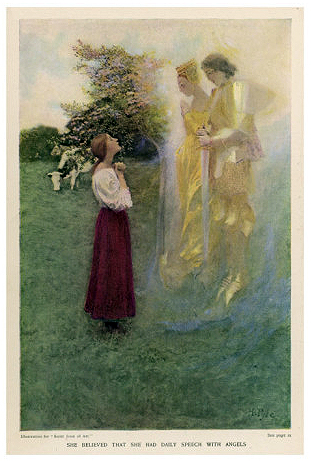
Around the age of thirteen, Joan began to experience what psychology now calls "auditory hallucinations." In other words, she heard "voices" — usually accompanied by a bright light — when no visible person was there. This, of course, is a common symptom of impending mental disorder; but no insanity developed in Joan of Arc. She was naturally startled at first, but continuation led to familiarity and trust. The voices gave good counsel of a very mundane kind, as, for instance, that she "must be a good girl and go often to church." Soon, however, she began to have visions, seeing St. Michael, St. Catharine, and St. Margaret; she was also given instructions as to her Divine mission.
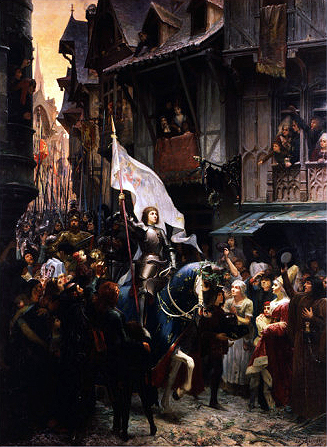
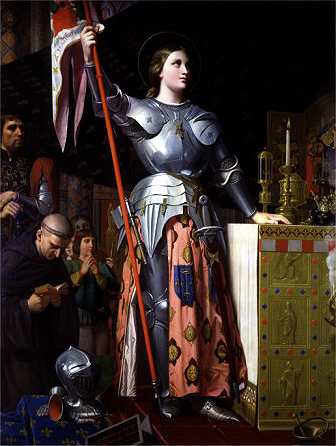
Joan of Arc eventually made her way to the Dauphin, put herself at the head of 6,000 men, and advanced to the relief of Orléans, which was surrounded by the victorious English. After a fortnight of hard fighting, the siege was raised, and the enemy driven off. The tide of war had turned, and in three months the Dauphin was crowned king at Rheims as Charles the Seventh (1429).
At this point, Joan felt that her mission was complete. But her wish to return to her family was over ruled by king and archbishop, and she took part in the additional fighting against the allied English and Burgundian forces, showing great bravery and tactical skill. But in November 1430, in a desperate rally from Compiégne — which was besieged by the Duke of Burgundy — she fell into the enemy's hands, was sold to the English, and thrown into a dungeon at their headquarters in Rouen.
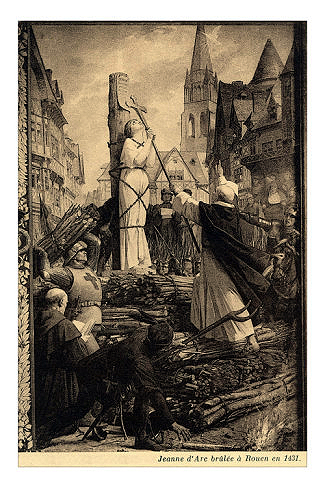
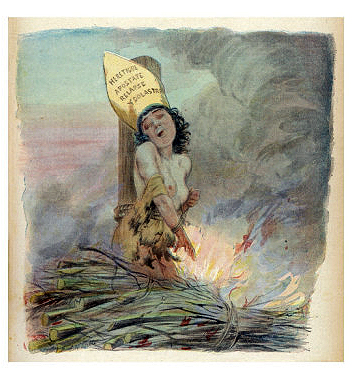
After a year's imprisonment she was brought to trial before the Bishop of Beauvais, in an ecclesiastical court. The charges were heresy and sorcery. Learned doctors of the Church, subtle lawyers, did their best to entangle the simple girl in their dialectical toils; but she showed a remarkable power of keeping to her affirmations and of avoiding heretical statements. "God has always been my Lord in all that I have done," she said. But the trial was only pretense, for her fate had already been decided. She was condemned to the stake. To the end, she solemnly affirmed the reality of her "voices," and the truth of her depositions. Her last word, as the smoke and flame rolled round her, was "Jesus." Said an English soldier, awestruck by the manner of her passing: "We are lost; we have burned a Saint." The idea was corroborated in popular opinion by the events that followed. Speedy death — as if by Heaven's anger — overtook her accusers and judges. Inspired by her example and claims, and helped by dissension and weakening on the side of the enemy, the French took heart once more; and the English were all but swept out of the country.
Joan’s family was rewarded by ennoblement, tinder the name of Be Lys. Twenty-five years after her death, the Pope acceded to a petition that the process by which she was condemned should be re-examined. The result was that the judgment was reversed, and her innocence established and proclaimed (1456). She was canonized in 1920.
The life of the Maid supplies a problem which orthodox science cannot solve. She was a simple peasant girl, with no ambitious desire after a career, who did rebell pathetically against her mission:
"I had far rather rest and spin by my mother's side, for this is no work of my choosing, but I must go and do it, for my Lord wills it."
She cannot be dismissed on the "simple idiot" theory of Voltaire, for her brilliance in war and her ability in repartee undoubtedly prove extraordinary mental powers, illiterate though she was in what we call education. We cannot call her a mere hysteric, for her health and strength were superb. It is on record that a man of science said to an Abbé:
"Come to the Salpétrière Hospital, and I will show you twenty Jeannes d'Arc."
To which the Abeé responded:
"Has one of them given us back Alsace and Lorraine?"
The retort was certainly neat. Still, though the Salpétrière hysterics have not won back Alsace and Lorraine, it is nevertheless true that many great movements have sprung from fraud or hallucination. May it not have been so with Joan? She delivered France, and her importance in history is great; but may not her mission and her doings have been the outcome of merely subjective hallucinations, induced by the brooding of her specially religious and patriotic mind on the woes of her country? The army, being ignorant and superstitious, would readily believe in the supernatural nature of her mission, and great energy and valor would result — for a man fights well when he feels that Providence is on his side.
This is the most usual kind of theory in explanation of the facts. But it is not fully satisfactory. How came that this untutored peasant girl could persuade not only the rude soldiery, but also the Dauphin and the Court, of her Divine appointment? How came she to be given the command of an army? Surely a position of such responsibility and power would not be given to an ignorant girl of eighteen, solely on the strength of her own claim to inspiration. It seems, at least, very implausible.
Now it so happens (though the materialistic school of historians conveniently ignores and belittles it) that there is strong evidence in support of the idea that Joan gave the Dauphin some proof of the possession of supernormal faculties. In fact, the evidence is so strong that Mr. Andrew Lang called it "unimpeachable" — and Mr. Lang did not usually err on the side of credulity in these matters. Among other curious things, Joan seems to have repeated to Charles the words of a prayer that he had made mentally; and she also made some kind of clairvoyant discovery of a sword hidden behind the altar of Fierbois church. Schiller's magnificent dramatic poem — "Die Jungfrau von Orleans" — though unhistorical in some details, is substantially accurate on these points concerning clairvoyance and mind reading.
Very good books on the Maid are those of Mr. Anatole France (The Life of Joan of Arc, 2 vols.), and Mr. Andrew Lang, giving respectively the believing and the skeptical side as to the explanation of her experiences. Another useful book is the one by Miss C. M. Antony, prefaced by Father R. H. Benson.
See Jean, Alchemy, Archangels, Angels, Angelical Stone, Critomancy, Astrology, Acutomancy, Agalmatomancy, Divination, Coscinomancy, Cleidomancy, Augur, Stoichomancy, Dowsing, Tarot, Heptameron, Demonology, Sortilege, Idolomancy, Demonomancy, Tephramancy, Anemoscopy, Eromancy, Austromancy, Chaomancy, Roadomancy, Capnomancy, Pyromancy, Meteormancy, Ceraunoscopy, Zoomancy, Christianity, Satan, Mystic Gifts and Charms - New Age Gift Shop & Wicca and Pagan Supplies, Love Spells -- Use these powerful love spells to help you find and keep your true love, The Tarot Store, The Chakra Store, Divination & Scrying Tools and Supplies, Unique Amulets, Talismans, Good Luck Charms, and Love Tokens, Powerful Witch Doctor Spell Kits, Powerful Spells - Cast by Andreika the Witch, Webmasters Make $$$, AzureGreen - Celebrating All Paths to the Divine, ISIS - Tools for Your Soul's Journey, and The Pyramid Collection - Myth, Magick, Fantasy and Romance.
Sources: Article is scheduled to be reviewed.
| | |










 .
. .
.
 .
.