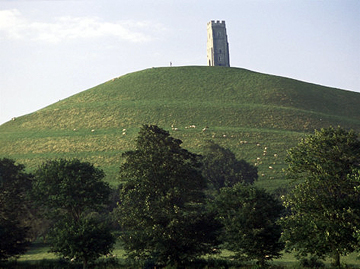
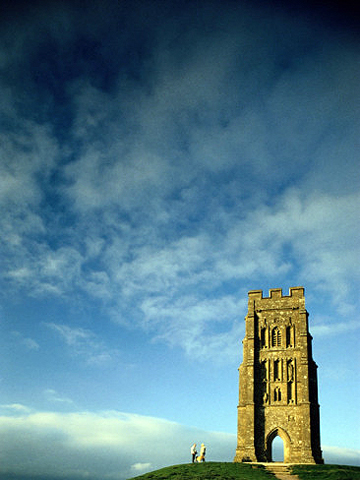
Located in the West Country, on the plains of Somerset Levels, not far from the Bristol Channel, Glastonbury is one of the oldest sacred sites in England. Its history is intertwined with the Holy Grail and Arthurian legends. The site includes an abbey, town, and Glastonbury Tor, a terraced volcanic rock topped with the remains of an old church tower.
The area is believed to rest at the intersection of powerful ley lines of earth energy. Its mystical lore draws numerous pilgrims and visitors from around the world. Archaeological evidence indicates the area was inhabited from the third or fourth century BC; the site may have been sacred to the Druids. The town was nearly on an island, surrounded by marshlands, until the sixteenth century, suggesting it may have been associated with the mysterious island of Avalon in Arthurian lore.
Various legends are associated with the Tor. One holds that King Arthur once had a stronghold atop the Tor, which provided entrance to Annwn, the underworld. Monks built a church there during the Middle Ages; it was destroyed in an earthquake. The present remains are of a later church. According to another legend, Chalice Well, located at the base of the Tor, is said to have been built by the Druids. Its reddish, mineral-laden waters are reputed to have magical powers. Another legend has it that Joseph of Arimathea, the great-uncle of Jesus, brought the boy Jesus on a trip to Glastonbury, and later built Britain's first aboveground Christian church below the Tor. He threw the chalice used by Jesus at the Last Supper into the Chalice Well (see Holy Grail).
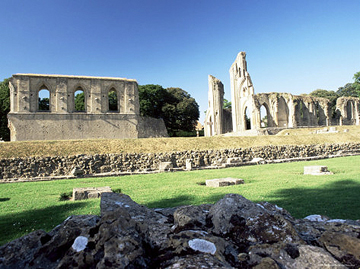
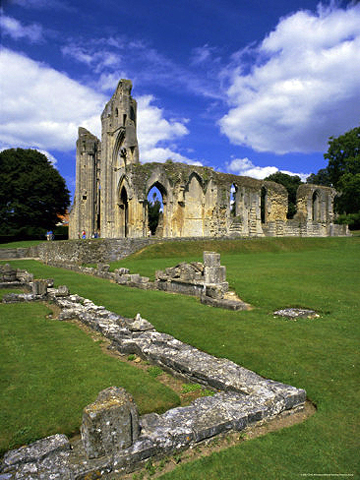
The abbey was founded in the fifth century. St. Patrick, the legendary founder, is said to have lived and died there and was buried there. Various churches were built at the site over the centuries. The last, dating from the 13th or 14th century, was destroyed under Henry VIII, who closed down all the abbeys and monasteries in 1539 after his split with the Catholic church. In the ruins of it, the famous Glastonbury Thorn blooms every year, said to be the staff of Joseph of Arimathea, which took root when he leaned upon it.
Arthur and Guinevere are buried in secret graves on the abbey grounds, according to legend. In 1190 monks found remains of a man and the inscription, 'Here lies the renowned Arthur in the Isle of Avalon'. The bones were reburied in a black marble tomb in 1278, which was destroyed in the dissolution of the abbey in 1539.
The ruins of Glastonbury were purchased by the Church of England in 1907 for excavation under the direction of Frederick Bligh Bond. Bond was extraordinarily successful in locating unknown chapels and parts of the abbey, and concluded that the abbey's construction had involved sacred geometry known by the builders of the Egyptian pyramids and passed down through the stonemasons. Bond claimed to have received helpful information from the spirits of monks who had lived there and who communicated to him through automatic writing (see Glastonbury scripts andpsychic archaeology). Bond's belief that Glastonbury is connected to Stonehenge and Avebury by leys has been upheld by modern ley investigators; the entire theory of leys, however, remains controversial.
In 1929 it was discovered that natural formations in the Glastonbury area recreate the twelve signs of the zodiac (see Glastonbury zodiac). The origins of the patterns are unknown.
Glastonbury is the site of Christian pilgrimages and seasonal rituals practiced by ritual magicians, witches, and pagans, and of various occult and spiritual festivals. Bright and fiery lights have been seen hovering over the Tor. They may be some form of unexplained natural energy. UFO watchers believe that they are connected with extraterrestrial spacecraft.
This website is best viewed with the latest
versions of
Microsoft
Internet Explorer or
Firefox.
Occultopedia
makes extensive use of
Flash and Scripting in its pages and interface. Make certain your browser
permissions are set
accordingly and that you have the latest
Flash plug-in for the full experience, proper look and accurate
layout. You can do it with confidence. This site does not contain any viruses, malicious software
or scripts.
Occultopedia is the genuine article, the
original and the best internet index of the extraordinary and uncanny,
shamelessly copied by many, but never equaled. Online since 1995 — at first in a free web space provider
(Tripod.com), and in 1997 finally
with its own domain name and hosting — Occultopedia still is the
principal online resource for those looking for the unexplained, the
curious and the unusual.
Occultopedia respects your privacy. As
such, no cookies or any other tracking software will be installed as a
part of this website's original programming. I do not seek to obtain any personal information
beyond what is volunteered through electronic communications
(e.g. emails & forms).
Occultopedia may appear to be a for profit site, but my site is
not in reality a commercial one. All of the commercial links are from affiliate
programs, and the little revenue I get from these is to pay for hosting,
bandwidth — that can be quite costly if you have a lot of traffic, graphics and
pages — and any other expenses related to Occultopedia's upkeep, support, and maintenance.
For more details, visit my
ordering
information page.
Occultopedia is a
FREE online
resource available to the whole world. Usage of my word definitions and articles
by educational institutions, teachers and students alike, is here by granted.
Reproduction for profit, and for display in another web site is strictly
forbidden, and will be handled as copyright infringement and prosecuted to the
full extent of the law. However, if you follow
some simple guidelines,
I will grant permission for limited reproduction. For more information, please consult my
intellectual property rights, warranties and
disclaimers information page. Support Occultopedia and make it your
online shopping
destination. If you prefer, you can also make a donation.
HELP FOOT THE BILL: this website
is created and maintained by one guy, who also pays the hosting bill.
Please donate if you like and/or use Occultopedia.
Participate in Occultopedia and submit a word
definition or article for the occult encyclopedia at my
entry submission
page. If you would like to suggest a web site or page for
addition into Occultopedia's links database, please go to my
URL submission page.







 .
. .
. .
.