Cagliostro, Count Alessandro (1743-95)
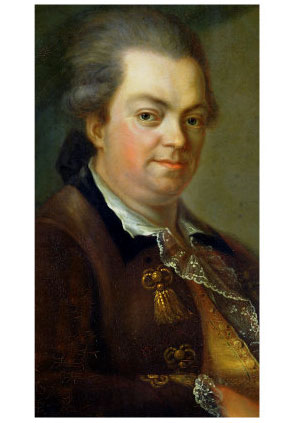
An Italian adventurer and self-styled magician who became a glamorous figure in the royal courts of Europe where he reputedly excelled in various occult arts, such as psychic healing, alchemy and scrying.
It was the fashion during the latter half of the 19th century to regard Cagliostro as a charlatan and impostor, and this point of view was greatly aided by the savage attack perpetrated on his memory by Thomas Carlyle, who alluded to him as the " Prince of Quacks." Recent researches, however, and especially those made by Mr. W. R. H. Trowbridge in his Cagliostro: the Splendour and Misery of a Master of Magic, go to show that if Cagliostro was not a man of unimpeachable honor, he was by no means the quack and scoundrel that so many have made him out to be.
His real name was Giuseppe Balsamo and he came from a poor family in Palermo, Sicily. From infancy Giuseppe showed himself averse to proper courses, and when placed in a local religious seminary, he more than once ran away from it, usually to be recaptured in undesirable company. Sent next to a Benedictine convent, he was under the care of a Father Superior, who quickly discovered his natural aptitude. Giuseppe became the assistant of an apothecary attached to the convent, from whom he learned the principles of chemistry and medicine.
Eventually young Giuseppe succeeded in escaping from the convent, and betook himself to Palermo where he associated with rascals and vagabonds. He was constantly in the hands of the police, and a kind uncle (mother's brother) of his who tried to assist him was rewarded by being robbed of a considerable sum. Engaged in every description of rascality, the youngster was even said to have assisted in the assassination of a wealthy canon. At this time it is asserted that he was only fourteen years of age.
After a crooked affair involving a stupid, superstitious and avaricious goldsmith named Marano, the young Giuseppe managed to escape to Messina, where he adopted the name of Alessandro Cagliostro and the title of " Count."
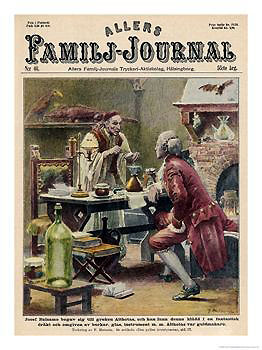
It was in Messina that Cagliostro met the mysterious Althotas, a mystical figure presumed to be his "master" and companion. In his company Cagliostro embarked in a great journey, going to Egypt, visiting the Pyramids, making the acquaintance of the priests of different temples, and receiving from them much hidden knowledge. Following their Egyptian tour they visited the principal kingdoms of Africa and Asia, and they are subsequently discovered at Rhodes pursuing alchemical operations.
When Cagliostro was 23 they went to Malta where he was initiated into the Order of the Knights of Malta. At Malta they assisted the Grandmaster Pinto, who was infatuated with alchemical experiments. Cagliostro studied alchemy, the Kabbalah and other occult secrets. From this time on Althotas completely disappears ― the memoir of Cagliostro merely stating that during their residence in Malta he passed away.
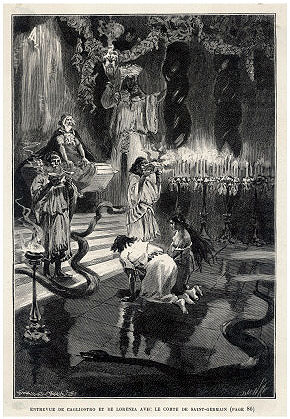
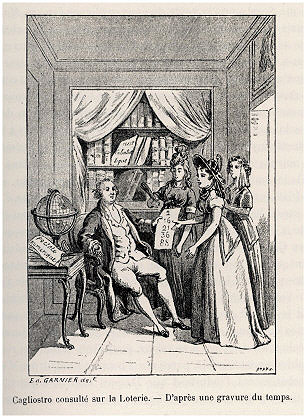
Later, in London, Cagliostro joined the Freemasons, and subsequently spent his life roaming the royal courts in Europe performing various occult arts and peddling magic potions and an 'elixir of immortal life' with the aid of his beautiful wife Lorenza Feliciani.
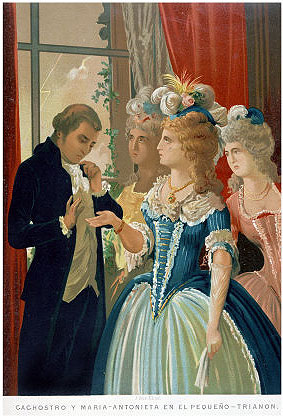
In 1785 Cagliostro became involved with the 'Queen's Necklace Affair': he was set up by Countess de Lamotte who swindled 1.6 million francs for a diamond necklace — supposedly for Marie Antoinette — and then accused Cagliostro of stealing it. He was sent to the Bastille and then tried for fraud.
After his release, Cagliostro ended up in Rome, where he attempted to create an 'Egyptian Freemasonry' order. He was imprisoned by the church, questioned by the Inquisition, and sentenced to death in 1791. His sentence was later commuted to life imprisonment by Pope Pius VI. After his death rumors that he had miraculously escaped and was still alive persisted for years throughout Europe, Russia and America.
See Rosicrucians, The Chakra Store, Mystic Gifts and Charms - New Age Gift Shop & Wicca and Pagan Supplies, Love Spells -- Use these powerful love spells to help you find and keep your true love, The Tarot Store, Divination & Scrying Tools and Supplies, Unique Amulets, Talismans, Good Luck Charms, and Love Tokens, Powerful Witch Doctor Spell Kits, Powerful Spells - Cast by Andreika the Witch, Webmasters Make $$$, AzureGreen - Celebrating All Paths to the Divine, ISIS - Tools for Your Soul's Journey, and The Pyramid Collection - Myth, Magick, Fantasy and Romance.
Sources: (1) Shepard, Leslie (editor), Encyclopedia of Occultism and Parapsychology, Thomson Gale; (2) Dictionary of the Occult, Caxton Publishing; (3) Steiger, Brad and Sherry Hansen, The Gale Encyclopedia of the Unusual and Unexplained, Thomson Gale; (4) Trowbridge, W. R. H., Cagliostro: the Splendour and Misery of a Master of Magic, Banton Press.
| | |








 .
. .
.