Black Magic
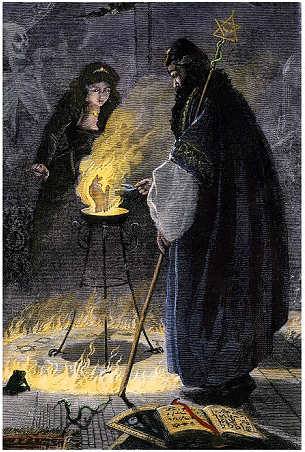
The conscious use of supernatural powers for the exercise of evil, the perversion of white magic. Magic that draws on evil and malevolent powers.
In occult lore white magic is concerned with expanding consciousness and improving the common good. Black magic is the selfish and squalid perversion of magical arts to destroy others, or for personal gain.
The black magician is, quite simply, a person who wants power for him/herself, or self-aggrandizement. They want to be able to vent their spite on enemies and to satisfy all of their desires. A magician may summon the Devil or one of his demons and remain a white magician, so long as the purpose for the summoning is benevolent. Black magicians are usually defined as those who made a pact with the Devil. They invoke diabolic and infernal powers for their personal use and gain; in short, a perversion of legitimate mystic science.
Lewis Spence wrote, in his An Encyclopedia of Occultism:
"In Black Magic human perversity found the means of ministering to its most terrible demands and the possible attainment of its darkest imaginings. To gain limitless power over god, demon and man; for personal aggrandizement and glorification; to cheat, trick and mock; to gratify base appetites; to aid religious bigotry and jealousies; to satisfy public and private enmities; to further political intrigue; to encompass disease, calamity and death—these were the ends and aims of Black Magic and its followers."
Black magic would be invoked to kill, injure, or cause destruction, or for personal gain without consideration to harmful consequences to others. As a term, black magic could be used to describe a form of ritual that some group or person does not approve of. Not everything that is called black magic truly has evil or malevolent intentions behind it. . .
See Brothers of the Shadow, Magic, Witchcraft, Diviner, Divination, Wizard, Pythagoras, Witch, Agrippa, Warlock, Alchemy, Paracelsus, Kabbalism, Numerology, Palmistry, Crystal Gazing, Tasseography, Mystic Gifts and Charms - New Age Gift Shop & Wicca and Pagan Supplies, Love Spells -- Use these powerful love spells to help you find and keep your true love, The Tarot Store, Divination & Scrying Tools and Supplies, Unique Amulets, Talismans, Good Luck Charms, and Love Tokens, Powerful Witch Doctor Spell Kits, Powerful Spells - Cast by Andreika the Witch, Webmasters Make $$$, AzureGreen - Celebrating All Paths to the Divine, ISIS - Tools for Your Soul's Journey and The Pyramid Collection - Myth, Magick, Fantasy and Romance.
Sources: (1) Spence, Lewis, An Encyclopedia of Occultism, Carol Publishing Group; (2) Pickering, David, Cassell Dictionary of Witchcraft, Cassell Academic; (3) The Encyclopaedia Britannica Eleventh Edition Handy Volume Edition, Oxford University Press; (4) Bailey, Nancy (editor), The Little Giant Encyclopedia of Spells and Magic, Sterling Publishing.
| | |







 .
. .
. .
.