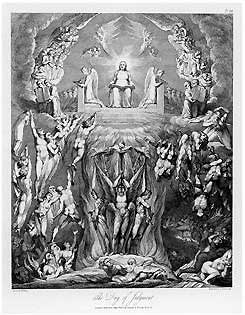
The Day of Judgment, God presides an angel sounds the last trump the virtuous, by Luigi Schiavonetti. . . — Buy this art print at AllPosters.com.
With the destruction of the ozone layer which "departed as a scroll "when it is rolled together" humankind will be forced to seek shelter wherever it can find it. The following verse (6:15) reveals how at that awful time everyone, from kings and rich men down to ordinary free men, will hide "themselves in the dens and in the rocks of the mountains".
Contemporarily this verse has been interpreted as the population escaping nuclear fallout in underground shelters, but it might also be some kind of ecological disaster.
In the next chapter St John envisions "four angels standing on the four corners of the earth, holding the four winds of the earth, that the wind should not blow on the earth, nor on the sea, nor on any tree". This verse invokes an eerie vision of a noiseless land with not a breath of wind, that pregnant pause before disaster hits.
Before the full horrific forces of destruction are released, a voice commands that the servants of God be identified by a mark on their foreheads so that they can escape harm. Interestingly, the same marking is carried out by the Beast, so that he, like God, will be able to distinguish his own.
Until this is completed, the avenging angels are commanded to "hurt not the earth, neither the sea, nor the trees" (7:3). This verse is practically a direct plea to our age to stop raping the earth, polluting the sea, and cutting down the once great forests of the Amazon.
Finally, after the seventh seal has been unlocked, there is a period of silence before "there were voices, and thunderings, and lightnings, and an earthquake" (8:5). The earthquake paves the way to widespread volcanic eruptions from which fire, hail and blood rain down on the vegetation. Then a "great mountain burning with fire" (8:8) turns the sea to a blood color, poisoning one-third of the fish in the oceans.
The third trumpet conveys yet greater destruction, "and there fell a great star from heaven, burning as it were a lamp, and it fell upon the third part of the rivers, and upon the fountains of waters". The star is named Wormwood, which does not appear in any catalogue of stars. The word is used as a pun on the bitter herb which went into the making of the drink absinthe, "and the third part of the waters became wormwood; and many men died of the waters, because they were made bitter" (9:10-11) or poisonous.
This might point toward a poisoning of water supplies, possibly by some new plague from outer space. Another ambiguous passage concerns a type of poisonous locust which is sent to plague mankind.
When the fourth trumpet sounds more cosmic changes occur, reminiscent of Velikovsky's theories of cosmic cataclysm: "the third part of the sun was smitten, and the third part of the moon, and the third part of the stars; so as the third part of them was darkened, and the day shone not for a third part, and the night likewise" (8:12).
These are the passages in the Apocalypse of St John which seem to have ecological disaster significance.
This website is best viewed with the latest
versions of
Microsoft
Internet Explorer or
Firefox.
Occultopedia
makes extensive use of
Flash and Scripting in its pages and interface. Make certain your browser
permissions are set
accordingly and that you have the latest
Flash plug-in for the full experience, proper look and accurate
layout. You can do it with confidence. This site does not contain any viruses, malicious software
or scripts.
Occultopedia is the genuine article, the
original and the best internet index of the extraordinary and uncanny,
shamelessly copied by many, but never equaled. Online since 1995 — at first in a free web space provider
(Tripod.com), and in 1997 finally
with its own domain name and hosting — Occultopedia still is the
principal online resource for those looking for the unexplained, the
curious and the unusual.
Occultopedia respects your privacy. As
such, no cookies or any other tracking software will be installed as a
part of this website's original programming. I do not seek to obtain any personal information
beyond what is volunteered through electronic communications
(e.g. emails & forms).
Occultopedia may appear to be a for profit site, but my site is
not in reality a commercial one. All of the commercial links are from affiliate
programs, and the little revenue I get from these is to pay for hosting,
bandwidth — that can be quite costly if you have a lot of traffic, graphics and
pages — and any other expenses related to Occultopedia's upkeep, support, and maintenance.
For more details, visit my
ordering
information page.
Occultopedia is a
FREE online
resource available to the whole world. Usage of my word definitions and articles
by educational institutions, teachers and students alike, is here by granted.
Reproduction for profit, and for display in another web site is strictly
forbidden, and will be handled as copyright infringement and prosecuted to the
full extent of the law. However, if you follow
some simple guidelines,
I will grant permission for limited reproduction. For more information, please consult my
intellectual property rights, warranties and
disclaimers information page. Support Occultopedia and make it your
online shopping
destination. If you prefer, you can also make a donation.
HELP FOOT THE BILL: this website
is created and maintained by one guy, who also pays the hosting bill.
Please donate if you like and/or use Occultopedia.
Participate in Occultopedia and submit a word
definition or article for the occult encyclopedia at my
entry submission
page. If you would like to suggest a web site or page for
addition into Occultopedia's links database, please go to my
URL submission page.









 .
. .
.










 Change Your Life!


