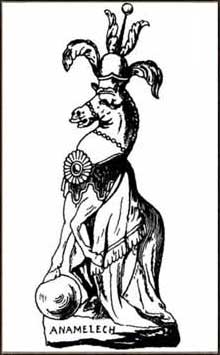
Anamelech
Alternatively Anammelech and Anu-malik ('Anu is the prince').
In Christian demonology, an obscure demon, said to be a bearer of ill news.
Anamelech was worshipped at Sepharvaim, an Assyrian town. The Serphavites burned their children as offerings on his and Adramelech's altars, believing that both gods were responsible for the health and welfare of their cattle.
In the Bible (2 Kings 17), there is a reference to this horrible practice:
"And they caused their sons and their daughters to pass through the fire, and used divination and enchantments, and sold themselves to do that which was evil in the sight of Jehovah, to provoke him to anger".
Anamelech was usually represented under the shape of a quail, but some Rabbins also depicted him as a mule. His name signified "gentle king," or "good king." Authorities declare that, for the Serphavites, this demon was the moon, as Adramelech was the sun.
Anamelech was the minion Satan charged with the task of recruiting Cain's soul. To accomplish this Anamalech sends Cain a vision in which he sees his children toiling in pain, while Abel's children enjoy luxury and ease. By the end of the vision the former have become the servants and slaves of the latter.
Awakening from this terrifying dream, Cain fiercely confronts Abel who, seeking mercy, wraps himself around Cain's feet. Anamelech again intervenes, causing Cain to be reminded of a deadly serpent as he sees his brother in this posture. Cain then murders Abel and, immediately overwhelmed with despair and anguish, flees into the wilderness.
Later, Anamelech further tortures Cain by tricking him, appearing several times as Abel's ghost, and thus causing him to be remorseful. This was done out of contempt for Satan, to whom Anamelech had fallen in disfavor.
After having lived his whole life racked by remorse caused by these ghostly visions, Cain finally seems to achieve some redemption by rushing to rescue a woman and some children from a tiger's attack in the wilderness — a group that turned out to be his own family.
See Heptameron, Demonology, Demonomancy, Grimoires, Witchcraft, Agrippa, Diviner, Divination, Wizard, Pythagoras, Witch, Warlock, Alchemy, Paracelsus, Devil, Kabbalism, Numerology, Alchemy, Magic, Satan, Mystic Gifts and Charms - New Age Gift Shop & Wicca and Pagan Supplies, Love Spells -- Use these powerful love spells to help you find and keep your true love, The Tarot Store, The Chakra Store, Divination & Scrying Tools and Supplies, Unique Amulets, Talismans, Good Luck Charms, and Love Tokens, Powerful Witch Doctor Spell Kits, Powerful Spells - Cast by Andreika the Witch, Webmasters Make $$$, AzureGreen - Celebrating All Paths to the Divine, ISIS - Tools for Your Soul's Journey, and The Pyramid Collection - Myth, Magick, Fantasy and Romance.
Sources: (1) Spence, Lewis, An Encyclopedia of Occultism, Carol Publishing Group; (2) Johnston, Kenneth R., The Hidden Wordsworth: Poet, Lover, Rebel, Spy, W. W. Norton & Company; (3) Bell, John, Bell's New Pantheon or Historical Dictionary of the Gods, Demi Gods, Heroes and Fabulous Personages of Antiquity, Kessinger Publishing; (4) Fliegelman, Jay, Prodigals And Pilgrims, Cambridge University Press.
| | |






 .
. .
. .
. .
.