Albertus Magnus
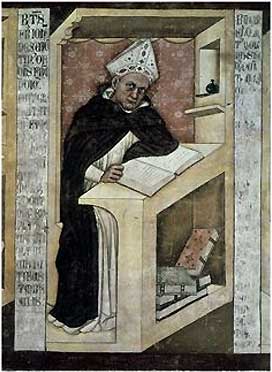
A German Dominican, who was canonized in 1931 by Pope Pius XI as Saint Albert the Great.
Albertus became famous for his wide-ranging knowledge and his unwavering promotion for the peaceful coexistence between science and religion, and is considered to be the greatest German philosopher and theologian of the Middle Ages.
He was both a student and teacher of alchemy and chemistry, and an alleged magician, since he was repeatedly charged by some of his unfriendly contemporaries with holding communications with the devil, practicing the craft of magic, and with the making of a demonic automata able to speak. He was also one of the alchemists reputed to have succeeded in discovering the Philosopher's Stone.
Albertus, also known as Albert of Cologne, was born at Larvingen, on the Danube, sometime between 1193 and 1206, and the term Magnus is not the result of his reputation, but is the Latin equivalent of his family name, de Groot. He died at Cologne, the exact date being unknown (some say 1280). His tomb is located at the crypt of the Dominican church of St. Andreas in Cologne.
A voluminous writer, no fewer than 38 folio volumes are attributed to him, although it is highly probable that some of these were penned by different authors. It is noteworthy to mention that, according to tradition, Albertus was the inventor of the pistol and the cannon, and while it is unlikely that the credit is due to him for these achievements, the mere fact that he was thus acknowledged points out that his scientific competence was recognized by the men of his time. He was also known for his enlightening commentary on the musical practice of the period, and wrote extensively on the subject.
After an alleged encounter with the blessed Virgin, Albertus stared espousing holy orders, and eventually won eminence in the clerical profession, being made Bishop of Ratisbon. He held this office for a short while, about three years, resigning it so that he might utilize all of his time doing scientific research. He spend the reminder of his life throughout Bavaria and the adjoining districts, partly in retirement in the various houses of his order. Albertus also preached the 8th Crusade in Austria, and among the last of his efforts was the defense of the orthodoxy of his former pupil, Thomas Aquinas, whose death in 1274 greatly grieved him.
See Alchemy, Mystic Gifts and Charms - New Age Gift Shop & Wicca and Pagan Supplies, Love Spells -- Use these powerful love spells to help you find and keep your true love, The Tarot Store, The Chakra Store, Divination & Scrying Tools and Supplies, Unique Amulets, Talismans, Good Luck Charms, and Love Tokens, Powerful Witch Doctor Spell Kits, Powerful Spells - Cast by Andreika the Witch, Webmasters Make $$$, AzureGreen - Celebrating All Paths to the Divine, ISIS - Tools for Your Soul's Journey, and The Pyramid Collection - Myth, Magick, Fantasy and Romance.
Sources: (1) Spence, Lewis, An Encyclopedia of Occultism, Carol Publishing Group; (2) Ephraim, Chambers, Cyclopaedia (An Universal Dictionary of Arts and Sciences), Rivington et al Straham (1778).
| | |












 .
. .
.