Agrippa Von Nettesheim, Heinrich Cornelius (page 2)
Agrippa considered the relationship between matter and spirit in the light of various arts and sciences, including music, geometry and, especially important, astrology. Then he turns to the human soul and its relationship to the body, as revealed by necromancy — the summoning up of the spirits of the dead — and in the religions of all ages.
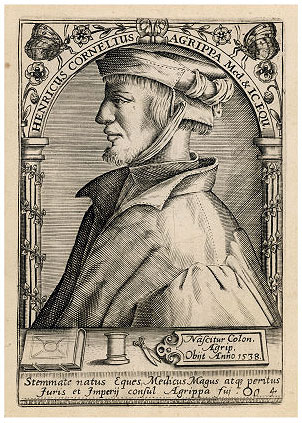
Agrippa builds up a system of the universe in which everything is part of a great spiritual whole, which is God. Magic is the way of investigating this system but magic is only for the initiated few, for men like Agrippa himself, members — as most of them were, in fact — of secret societies. He does not press the point fully home but his conclusion that man 'containeth in himself all things which are in God' is well in line with the magical theory that the magician call make himself God and wield the supreme power of God in the universe. Agrippa's other main work forms a complete contrast to his first one. Written in 1526, at a time when his fortunes were at a low ebb, and published three years later. De Incertitudine et Vanitate Scientiarum et Artium, (The Uncertainty and Vanity of the Sciences and Arts) maintains that on balance the arts and sciences are harmful to man. Through an encyclopedic review of all the science's and arts known to him, which provides a mine of information and holds up a fascinating mirror to the culture of the times, Agrippa contrasts the disillusion which all this knowledge brings with the spiritual strength gained through the only sure and beneficial thing on which man can rely — the divinely revealed word of God.
Agrippa was rarely an original thinker and his philosophy is a compilation of ideas from many sources. He ransacked the works of writers ancient and modern for ideas which he adapted in a tremendous display of erudition to his own magical system. But second-hand though much of his occult lore is, it is shot through with moments of genuine poetic utterance.
One of the many stories told about Agrippa was that he went out one day, leaving the key of a secret room in the house with his wife. She foolishly lent it to the lodger, a student, who went into the room and found a huge book of spells, which he began to read. After a while he looked up and found a demon standing in front of him, asking why it had been summoned. He gaped at it in horror and the demon strangled him. Agrippa returned and, fearing a charge of murder, made the demon restore the student to life for a few hours. The young man was seen walking in the street but when the demon's magic wore off, he collapsed.
Another often talked about story is that Agrippa always had by his side a large black dog, rumored to be his familiar. At his death bed, Agrippa apparently renounced his magical works and addressed his familiar thus:
"Begone, wretched animal, the entire cause of my destruction!"
It is said that the animal fled from the room and straightway plunged into the Saom, where it perished.
On yet another tall tale, it is said that at the inns where he stayed, Agrippa paid his bills with money that appeared genuine enough at the time, but which, after his departure, turned into worthless horn or shell, like the fairy money that turned to earth after sunset.
Of Agrippa's contemporaries, Paracelsus was far the greater genius but Agrippa, with his virtues and vices, provides the best mirror to the social and intellectual ferment of his time.
See Diviner, Divination, Wizard, Pythagoras, Witch, Agrippa, Warlock, Alchemy, Paracelsus, Mystic Gifts and Charms - New Age Gift Shop & Wicca and Pagan Supplies, Love Spells -- Use these powerful love spells to help you find and keep your true love, The Tarot Store, The Chakra Store, Divination & Scrying Tools and Supplies, Unique Amulets, Talismans, Good Luck Charms, and Love Tokens, Powerful Witch Doctor Spell Kits, Powerful Spells - Cast by Andreika the Witch, Webmasters Make $$$, AzureGreen - Celebrating All Paths to the Divine, ISIS - Tools for Your Soul's Journey, and The Pyramid Collection - Myth, Magick, Fantasy and Romance.
Sources: (1) Spence, Lewis, An Encyclopedia of Occultism, Carol Publishing Group; (2) Randi, James, An Encyclopedia of Claims, Frauds, and Hoaxes of the Occult and Supernatural, St. Martin's Griffin; (3) The Encyclopaedia Britannica Eleventh Edition Handy Volume Edition, Oxford University Press; (4) The Catholic Encyclopedia, The Encyclopedia Press.
| | |