|
|
|
| |
|
Adytum
From the
Greek aduton, which means 'not to be
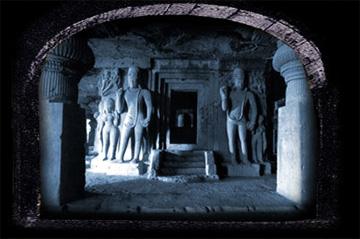
entered', this term defines the holy of holies and denotes the holiest part of a temple,
into which the public is not admitted. In ancient temples it was also a secret chamber, a
private altar, a sacred compartment or a
place of retirement. Sometimes, the place where oracles were given. None
but the officiating priests were permitted to enter. Generally, any sanctum, the innermost sanctuary in a
temple.
In occultism it refers to the holiest area of an
initiation center. According to some occult
traditions and secret societies accounts — such as the
Freemasons — in the adytum was usually kept a
Tafov, or tomb,
and
sometimes also sacred relics and/or images of the god to whom the temple was
consecrated. In some cases the Adytum was
completely walled in, with no doors
or windows, suggesting the practitioners believed in soul or spirit projection,
the only vehicle through which to enter.
In Christian architecture it sometimes signifies the
chancel, or altar end of a church. Among the Jews it means the
Kodesh Hakodashim, the Holy of Holies, the
Sanctum Sanctorum at the
temple in Jerusalem, where the light never shined.
In Egypt, the Adyta, usually
consisting of three blocks or pillars, answering to those of wisdom,
strength, and beauty; also representing the mysterious Triad of the
Deity; the
Secos
— as described by
Strabo — were the same thing.
The adytum of the small temple of
Pompeii is still in excellent
preservation. It is carried some steps above the level of the main
building, and, like the Jewish sanctuary, is without light.
The most famous adytum in Greece was in the temple of
Apollo at
Delphi.
See
Freemasonry,
Casting Black Magic Spells,
Commanding Spirits,
The Tarot Store and
Divination & Scrying Tools and
Supplies.
Sources: (1)
Dictionary of the
Occult, Caxton
Publishing;
(2)
The Catholic Encyclopedia,
The Encyclopedia Press; (3)
The Encyclopaedia
Britannica Eleventh Edition Handy Volume Edition, Oxford University Press;
(4) Mackey, Albert G., and Clegg, Robert I.,
Mackey's Revised
Encyclopedia of Freemasonry, The Masonic History Company.
|
|
|
|
|
|

| |
|
|
This website is best viewed with the latest
versions of
Microsoft
Internet Explorer,
Firefox or
Netscape.
Occultopedia
makes extensive use of
Flash and Scripting in its pages and interface. Make certain your browser
permissions are set
accordingly and that you have the latest
Flash plug-in for the full experience, proper look and accurate
layout.
If using
Microsoft
Internet Explorer 7, clicking (or pressing the SPACEBAR or ENTER) on the
Flash graphics is necessary to activate it. If using the latest versions
of
Firefox or
Netscape, adjusting the browser
trust permissions to "ENABLE MAXIMUM SITE FUNCTIONALITY" is required to fully
enjoy Occultopedia's features and
Flash graphics. You can do it with confidence. This site does not contain any viruses or any malicious software
or script.
|
|
As you may have noticed, Occultopedia is being updated.
Navigation areas are completed, but the word definition pages are not. The
layout in these pages might not look as good as they should. Updating them
may take a while, so please, be patient and understanding. I am only one
person working on this site in my spare time.
As soon as these updates are concluded I will begin setting up the
Forums, so we can all discuss the
occult, paranormal and extraordinary, and whatever else we please.
Registration will be required.
Occultopedia's images and art are also undergoing an adjustment to
Flash based graphics. This process may take some time as well, so again, be
patient and understanding.
|
|
|
|
| |
|
|
Occultopedia is the genuine article, the
original and the best internet index of the extraordinary and uncanny,
shamelessly copied by many, but never equaled. Online since the
early 90s — at first in a free web space provider, and in 1997 finally
with its own domain name and hosting — Occultopedia still is the
principal online resource for those looking for the unexplained, the
curious and the unusual. |
|
Occultopedia respects your privacy. As
such, no cookies or any other tracking software will be installed as a
part of this website's original programming. I do not seek to obtain any personal information
beyond what is volunteered through electronic communications
(e.g. emails & forms).
|
|
Occultopedia may appear to be a for profit site, but my site is
not really a commercial one. All of the commercial links are from affiliate
programs, and the little revenue I get from these is to pay for hosting,
bandwidth — that can be quite costly if you have a lot of traffic, graphics and
pages — and any other expenses related to Occultopedia's upkeep and maintenance.
For more details, visit my
ordering
information page.
Occultopedia is a
FREE online
resource available to the whole world. Usage of my word definitions and articles
by educational institutions, teachers and students alike, is here by granted. For more information, please consult my
intellectual property rights, warranties and
disclaimers information page. Support Occultopedia and make it your
online shopping
destination. If you prefer, you can also make a donation.
|
|
HELP FOOT THE BILL: this website
is created and maintained by one guy, who also pays the hosting bill.
Please donate if you like and/or use Occultopedia.
|
|
Participate in Occultopedia and submit a word
definition or article for the occult encyclopedia at my
entry submission
page. If you would like to suggest a web site or page for
addition into Occultopedia's links database, please go to my
URL submission page.
|
|
|
|
|
Site
creation and design
by M. V. G.
|
Copyright
© Occultopedia™ . All rights reserved. |
| |