Venice, Italy
World renowned city of canals and bridges.
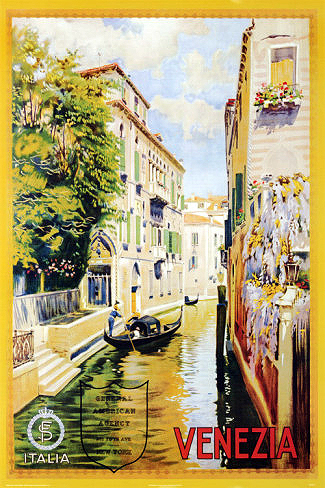
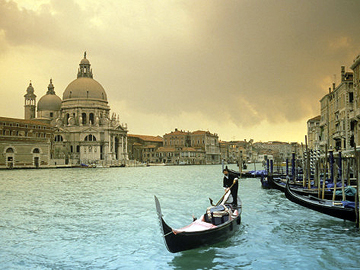
Venice's canals and bridges facilitate internal transportation and have a beauty and charm that draw countless visitors each year. Chief among these arteries is the S-shaped Canale Grande — the Grand Canal which starts at the railway station and parking garage on Piazza Roma and ends at Piazza San Marco (St. Mark's Square).
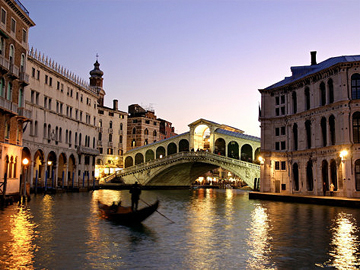
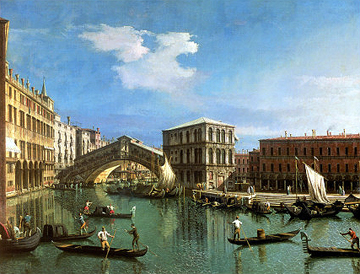
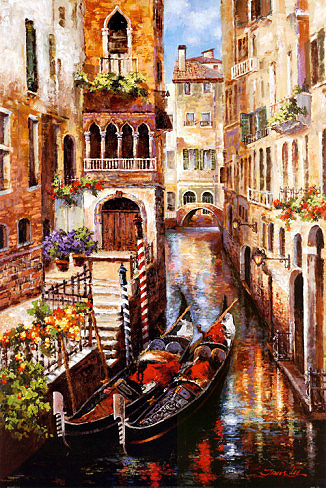
Altogether there are more than 200 canals, which are literally the streets and avenues of Venice. Crossing the waterways are about 400 bridges, the most famous of which is probably the Rialto.
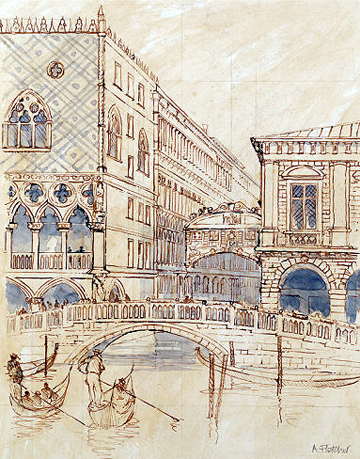
Others include the Scalzi, the Accademia, and the infamous Bridge of Sighs, which leads from the upper story of the Doges' Palace to the republic's prison. Centuries ago prisoners went over it to their secret and often tortured deaths. The center is connected to the mainland by viaducts, which carry a major highway and a double-track rail line. Large cruise vessels and freighters move to the Stazione Marittima (marine station) nearby.
Within the Venetian islands, canals, and lagoons, commodities move by barges and tugs, while passenger movement is primarily by vaporetti (motorboats).
The world-famous black gondolas, propelled by gondoliers, are narrow with high prows and sterns and are used mainly for short canal passages. They are mainly the vehicles of merchants, politicians, and tourists.
Once a city-state that as a great maritime power served as a bridge between East and West, Venice is now one of the great cultural centers of Europe. It attracts thousands of tourists each year. It serves as the capital of the province of Venice (Venezia) and the Veneto region.
The historic center of Venice is built on a group of islets and mud-banks in the middle of Laguna Veneta, a crescent-shaped lagoon separated from the Adriatic Sea by a barrier of narrow islands and peninsulas. The modern city embraces the whole 90-mile (145-kilometer) perimeter of the lagoon and includes ten principal islands in addition to those of the mother city and two industrial boroughs of Mestre and Marghera on the mainland. The main core includes the islands of La Giudecca; San Giorgio Maggiore, with its famous 16th-century church of the same name by the architect Andrea Palladio; and San Michele.
Other islands include the Lido, a resort built in the 19th century, with its casino, hotels, and beaches; Murano, noted for its glassworks; Burano, famous for its lace; and Torcello, site of the remains of the Santa Maria Assunta Cathedral.
Venice is separated from the sea by natural and artificial breakwaters, but flooding is common from November through March of each year.
Venice came about after the fall of the Roman Empire. Barbarian states — Goths, Ostrogoths, and later Lombards — swept over Italy in the 5th and 6th centuries AD; people who had lived on or near the northwest Adriatic coast found shelter on the scores of offshore islets in the Venetian lagoons, which had previously been inhabited by small numbers of fishermen. The political climate of that era was so unstable that the early inhabitants were ready to move into the swamps and lagoons, building their houses on pilings on the partially flooded islands. The main centers of settlement lay between the Piave River on the north and the Adige River on the south.
Over the centuries Venice grew into a great maritime power because of the astuteness of its merchants and rulers as well as its location in relation to the East. This city-state was never part of the old Teutonic empires. For centuries its main political, military, and commercial ties were clearly with Byzantium (Constantinople, now Istanbul).
See A History of Venice, Antonio Vivaldi: The Red Priest of Venice, Art and Life in Renaissance Venice, Byzantium and Venice, City Culture and the Madrigal at Venice, Portrait of Venice, The Art of Renaissance Venice: Architecture, Sculpture, and Painting, 1460-1590, Mystic Gifts and Charms - New Age Gift Shop & Wicca and Pagan Supplies, Love Spells -- Use these powerful love spells to help you find and keep your true love, The Tarot Store, The Chakra Store, Divination & Scrying Tools and Supplies, Unique Amulets, Talismans, Good Luck Charms, and Love Tokens, Powerful Witch Doctor Spell Kits, Powerful Spells - Cast by Andreika the Witch, Webmasters Make $$$, AzureGreen - Celebrating All Paths to the Divine, ISIS - Tools for Your Soul's Journey, and The Pyramid Collection - Myth, Magick, Fantasy and Romance.
Sources: Article is scheduled to be reviewed.
| | |








 .
. .
. .
.
 .
. .
.