Gévaudan, Beast of
Creature depicted as a gigantic wolf-like quadruped
(witnesses reported it as big as a
donkey or cow) that
over two hundred years ago terrorized people in southeastern France by killing
men, woman and children. Many explanations — mutant, prehistoric beast, demon,
very large baboon, etc. — were put forward at the time and during the two centuries since, but none has ever been generally accepted.
One thing is certain: sufficient evidence remains to prove that 'La Bête' —
French for 'The Beast', as the creature became known — really did exist and was not just a myth.
This monstrous animal
terrorized the people of Gévaudan — a district in Lozère — for more
then three years, and it is said it killed about one hundred human beings
(and wounded over thirty), without mentioning a large number of cattle and other domestic animals.
It all stared in June
1764 in the Merçoire forest near Langogne in the eastern part of
Gévaudan, when a young woman watching a heard of cows suddenly saw a gruesome
beast charging at her. Had not the bulls kept the monster at bay with their
horns, she most certainly would have been devoured. After the bulls
successfully repelled a second charge, the lucky woman managed to escape
with just minor scratches and torn clothes.
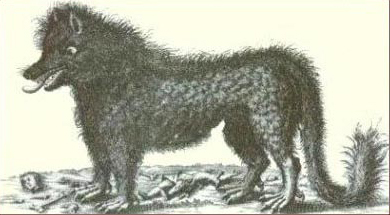
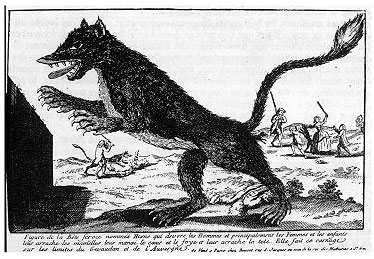
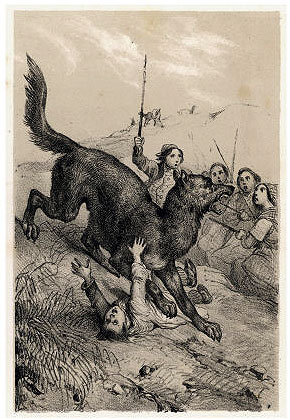
The animal was hysterically described by the lass as having a very wide chest, a
huge head and neck, short straight ears that looked like erect horns and a nose like a greyhound, with two
long fangs protruding from each side of its black foaming mouth. Its tail was long and
exceptionally thin and it had a black stripe running from the top of the head to
the tip of the tail. It also had enormous claws, which looked like a man's hand only three times larger, and its eyes glinted red
and looked devilish. The young woman also said that it moved at a high speed, in
leaps and bounds of as much as thirty feet (nine meters).
|

|
|
|
|
|
In the following months
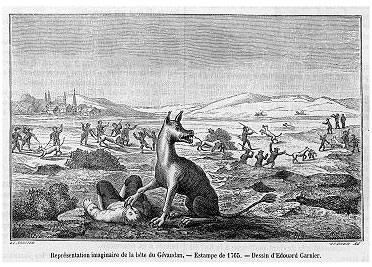
terror swept the region. The beast favored easy prey — women and
children, and also lone men who took livestock out to pasture — often
aiming for the head of its victims. Several were devoured and carried off.
Worse of all, half-eaten bodies and torn-off limbs scattered about. A few of the victims got away with their lives, but most of these went mad from shock.
There was rampant speculation that the creature was actually a loup-garou
(werewolf). Others speculated that there were a pair —
or even a pack — of extremely large and strangely
colored man-eating creatures, instead of only one animal, because of the high
number of attacks and also because it seemed to be able to either move
incredibly fast or to be in two places at almost the same time. Guns
seemed useless, for even when someone shot at the beast, it apparently
remained unharmed. The creature came to be regarded more and more as a
supernatural fiend.
In October 1764 two
hunters spotted the beast and shot it from only ten paces. The creature
fell, only to get up again immediately. A second round of shots, and again
the beast fell. This time the animal got up on unsteady legs, but still
managed to escape to a nearby wood. As it made its escape, the hunters
shot at twice more, and at each time the beast fell, only to rise again.
Locals, after hearing
about it and seeing the blood trail leading to the woods, were sure that
this time the creature was mortally wounded, and that it would be found
dead the next day. To their great horror, several more people were killed
in the next days. The legend
— and the fear — grew even more.
The next month enormous
beats composed of every available peasant were organized by a certain
Captain Duhamel, who led fifty-seven of his dragoons (forty on foot and
seventeen mounted) on a massive hunt for the creature. His efforts were useless. The
beast proved to be too much for them, escaping every time Duhamel's
dragoons thought they had it trapped. The
men went as far as dressing
like women to lure the creature with the prospect of an easy kill, but the
animal still managed to avoid being captured or killed.
A large reward was then
offered, and hunters from all over came to Gévaudan
hoping to win the money. These hunters joined the dragoons, and the hunt
went on for months. Over one hundred wolves were killed, but the beast still eluded everyone. In the end
disgruntled peasants had had enough of these outsiders eating their bread,
trampling their fields and invading their houses. Incredibly, as if it had
sensed the animosity between the populace and the hunters, 'La Bête'
unleashed a massacre more terrible then before — right under everyone's
noses. By this time, stories of the invincible 'Beast of Gévaudan' had
reached every corner of Europe.
After
a brutal and public attack on two young children, King Louis XV sent a certain Denneval
to the district. Denneval, a Norman squire and hunter reputed to have killed
more than twelve hundred wolves, began tracking the beast with six of his best
bloodhounds in February 1765. Not long after that a local farmer's courageous
sixteen year-old son, Jacques Denis, joined up with Denneval, and they became
friends. Jacques twenty year-old sister Jeanne had been attacked by 'La Bête',
and although surviving the encounter with two gapping wounds behind each ear and
a torn shoulder, she went mad never to recover. Jacques, a witness to the
mauling, had sworn to avenge his sister.
|
|
|
 |
|
On April 29, 1765, a
local nobleman called Chaumette and his two brothers came upon the beast
as it was stalking a shepherd. They shot at it, and the animal collapsed
on the ground, rolling over two or three times. They fired again. The
beast rolled over to a nearby wood, managed to gain shelter and fled. But
this time a lot of blood stained the soil and bushes all around. Everyone
hoped it had gone away to die alone in the bushes. It proved to be a false
hope. Shortly after the beast was back on its bloody rampage.
This time the beast
attacked at the great spring fair held at Malzieu in May 1765. It stared
by killing a young lady named Marguerite, who by a strange coincidence
happened to be a very good friend of Jacques Denis. Afterwards, the
creature killed three other victims on that same day. This was the last
drop. Enraged peasants grabbed pitch forks and bayonets, and led by
Jacques put their dogs onto the still-fresh scent. Soon enough they found
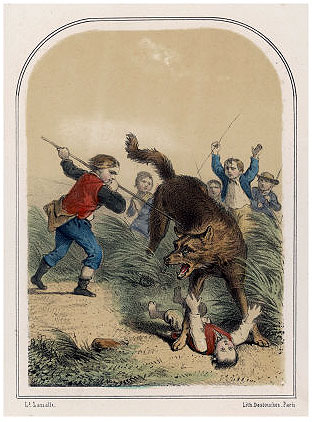
themselves face to face with 'La Bête', Jacques for the second time. He
attacked the animal violently with his bayonet, but the beast remained
unconcerned, leaping at the young man. If not for the arrival of more
hunters prompting the beast to flee, Jacques would have joined his friend
Marguerite in the afterlife. In June 1765, Denneval gave up the hunt.
The beast, as if it had
sensed the departure of its enemy, went on a rampage. On June 16 it
attacked and mangled a little girl, who fortunately was saved by villagers
at the last moment. On the 21st, 'La Bête' killed a fourteen year-old
boy, devoured a forty-five year-old woman and carried off a little child.
A furious King then charged his personal gun carrier, Antoine de Beauterne,
with the demise of the problematic beast.
The King's emissary did
little at first. He surveyed the area, drew some maps of the animal's
routes, and inspected the environment. Then, on September 21st, he
organized a beat composed of forty local hunters and 12 dogs.
This time things seemed
to be going all right. Guided by his intuition, de Beauterne had the men
encircled a ravine in the woods near the village of Pommier. As soon as
the dogs were unleashed, they stared to bark furiously. 'La Bête' was
there! Antoine de Beauterne's approach and intuition had paid off.
As the beast came out
of the brush, it immediately became aware that it was surrounded. Desperately,
it tried to find a hole in the trap. De Beauterne fired, hitting the beast
in the right shoulder. The hunters also opened fire, and one shot went
right through the animal's right eye and its skull. The creature fell, as
the men sounded the horn in triumph.
Suddenly, to everyone's
surprise and bafflement, the beast rose and charged at de Beauterne. The
men fired again, and again the creature was hit. 'La Bête' turned around
and tried to escape once again, but it finally collapsed — dead at last!
Upon examination, the
animal proved to be an enormous rare type of wolf measuring a little over
6 feet (1.8 meters), weighing 143 pounds (65 kilograms), with a huge head
and fangs about 1½ inches (3.5 centimeters) long.
There was great
rejoicing in the region's villages. 'The beast is dead! The beast is
dead!' But still many folk would not dare to believe it was true,
including Jacques Denis' other sister, Julienne:
"I know it is
still alive, out there, watching us from the shadows! It will get me, I
just know it!"
For the next couple of
months no ominous alarm bells were heard at the villages, but just because
of the King's order forbidding anyone to speak of the beast. The killings
went on, and Julienne disappeared, never to be seen again, on Christmas
Day.
For the next year
(1766) things were much calmer, with just a few disappearances. But in the
spring of 1767 the massacres resumed, although it is not known how many
were killed: many families did not admit to the deaths and the authorities
no longer registered them. But somehow it came to light that from March to
June 1767 there were 14 victims of the beast, all in an area 3 miles (5
kilometers) long near the town of Paulhac.
On June 19 a local
nobleman organized a huge beat, composed of over three hundred hunters and
beaters. Jean Chastel, an acquaintance of Jacques and Julienne Denis, came
along armed with his gun and blessed silver bullets. He positioned himself
on a prime spot to get first bids on the creature, and opened a prayer
book.
As Chastel preyed,
suddenly there was a rustling at the edge of the woods. The beat had
worked, and the creature sprang from the brush. It stopped surprised, a
few steps in front of Jean Chastel, which in turn raised his gun and fired
once, twice. The beast fell, dead. Just as the animal killed by Antoine de Beauterne it actually looked remotely similar to a wolf, but it was
abnormally bigger than any local wolves ever seen.
Upon gutting the creature, remains of a small girl were found inside it.
The animal was embalmed and taken from town to town so people,
for a small fee, could have a look at it. The King however wanted it to be exhibited at the royal palace, so Jean himself went to Versailles with the body. Unfortunately,
embalming techniques were not very good at the time, so when they reached the palace
the carcass was starting to stink. After a few days of displaying the
creature's corpse at his court, the King — upset by the smell — ordered it buried at once.
One week after the killing of the creature, during a hunting party
organized by marquise Labesseyre-Saint-Mary, a hunter named Jean Terrisse killed a giant female
wolf. It was considered that this was the mate of the monster. After the slaying
of these two animals no more attacks were reported.
Related
books:
The
Complete Book of Werewolves.
Wolf-Hunting
in France in the Reign of Louis XV: The Beast of the Gevaudan.
Further
info:
La Bête du Gévaudan.
The Beast
of Gévaudan (geocities.com).
The
Beast of Gévaudan (shanmonster.bla-bla.com).
The
Beast of Gévaudan and Other "Maulers".
The
Unexplained Site - Beast of Gévaudan.
|