Divination (page 2)
All divination, by whatever method, follows the same pattern:
1. A question is formulated, ranging from something very specific — such as "Should I marry this woman?" or "Will I win at the races today?" — to general enquiries of the type "What will my future life be like?"
2. A physical mean is used to provide a connection between the enquirer and the diviner — such as an intimate possession, to touch the seer, or to make an arbitrary choice of cards or objects, or any random arrangement of things from which he does not make a conscious selection. Or the diviner may utilize some device, such as a pendulum or crystal ball, on which he can concentrate so intensely that the perception of his surroundings withdraws to the point where he is effectively in a trance. Drugs are sometimes used for this purpose.
Divination is not concerned with predetermined events. The diviner can give advice only on the basis of predicting the outcome of a particular course of action, maybe suggesting an alternative; but he cannot state that any future event will definitely occur.
Every age has had its share of visionaries, seers who seem to posses a kind of second sight that enables them to peer through the walls of time. And it is not the past or the present, but the future that holds the greatest allure for would-be soothsayers; and not just any future, but the fascinating matter of human fate — be it the destiny of an individual, of a nation, of the world or of the universe.
In Babylon, supposedly god-inspired kings may have been the first prophets. In the Gilgamesh epic, believed to have been first recorded as long ago as 2000 BC, the semi-divine ruler dreams about an upcoming fight; his mother, a goddess, tells him that he and his enemy will then become fast friends. And it came to pass, just as Gilgamesh had been told in his dream.
The legendary Sumerian king Enmenduranna, who was supposed to have lived before the Flood, was said to have codified the rules of prophesy. Certainly the seer's art was well developed by the time of the First Dynasty of Ur, around 2500 BC. Prophecies were delivered in the name of the ruler and said to be inspired by the gods, but they were made by professional seers, who developed a number of divinatory systems involving inspection of sheep's livers and other natural objects.
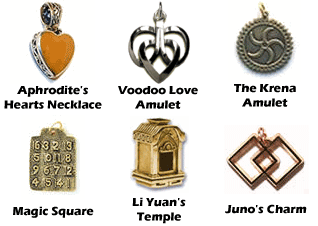
See Augur, Dowsing, Tarot, Heptameron, Demonology, Sortilege, Demonomancy, Mystic Gifts and Charms - New Age Gift Shop & Wicca and Pagan Supplies, Love Spells -- Use these powerful love spells to help you find and keep your true love, The Tarot Store, The Chakra Store, Divination & Scrying Tools and Supplies, Unique Amulets, Talismans, Good Luck Charms, and Love Tokens, Powerful Witch Doctor Spell Kits, Powerful Spells - Cast by Andreika the Witch, Webmasters Make $$$, AzureGreen - Celebrating All Paths to the Divine, ISIS - Tools for Your Soul's Journey, and The Pyramid Collection - Myth, Magick, Fantasy and Romance.
 | | | | |
| | |
| |
Sources: (1) Dictionary of the Occult, Caxton Publishing; (2) Spence, Lewis, An Encyclopedia of Occultism, Carol Publishing Group; (3) Steiger, Brad and Sherry Hansen, The Gale Encyclopedia of the Unusual and Unexplained, Thomson Gale; (4) The Encyclopaedia Britannica Eleventh Edition Handy Volume Edition, Oxford University Press; (5) Bailey, Nancy (editor), The Little Giant Encyclopedia of Spells and Magic, Sterling Publishing; (6) Dunwich, Gerina, A Wiccan's Guide to Prophecy and Divination, Carol Publishing Group.
| | |






 .
. .
. .
. .
. .
. .
.