Dinosaur
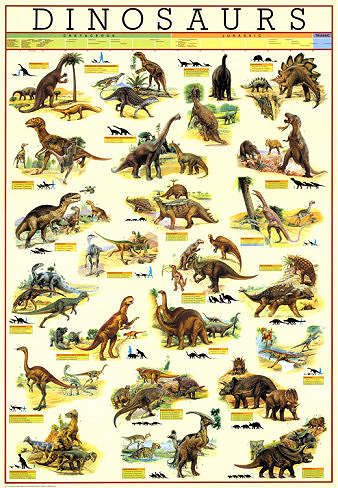
Any member of a group of about 350 well-known genera of archosaurian reptiles that first appeared in the late Middle or early Late Triassic period, about 200 million years ago. Dinosaurs comprise two orders, the “bird-hipped” Ornithischia and the “reptile-hipped” Saurischia. The earliest known dinosaurs, such as Staurikosaurus and Herrerasaurus from South America, are too primitive to be classified within either order.
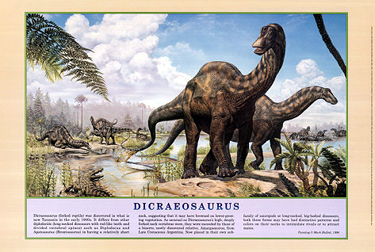
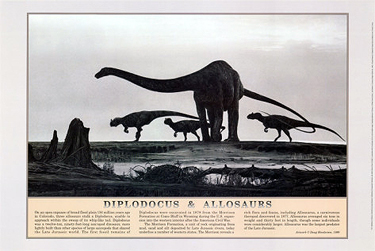
Dinosaurs arose at a time when the land was dominated by crocodile-like phytosaurs, giant amphibians and archosaurian carnivores, and large therapsids. The first dinosaurs were small, lightly built, bipedal carnivores or omnivores that were probably quicker and more agile than their contemporaries, most of which became extinct by the end of the Triassic period. During the Jurassic period and Cretaceous period the dinosaurs evolved into myriad adaptive types, many of which reached colossal size.
| |  | | | |
| |
Do dinosaurs still exist? The question may sound absurd, after all, conventional science holds that they have lapsed into extinction about 65 million years ago. Occasional reports from remote regions of the earth have kept this issue alive, if not only to readers of sensationalistic tabloid newspapers, to the handful of scientists, adventurers, and nature writers who have tried to make sense of these accounts and, where possible, to investigate them. The bulk of the investigation has been centered on a legendary creature generally referred to as Mokele-mbembe.
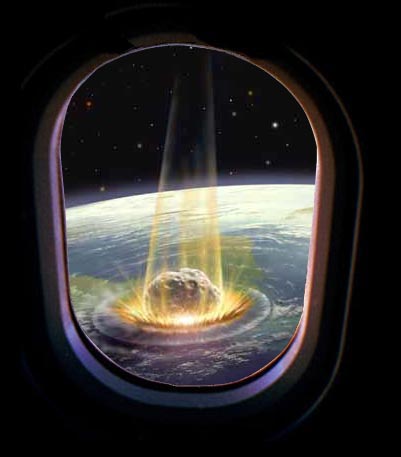
A controversial new study suggests that a huge asteroid smashing into Earth may have let dinosaurs take over the Earth 135 million years before another one wiped them out 65 million years ago.
A controversial new study suggests that a huge asteroid smashing into Earth may have let dinosaurs take over the Earth 135 million years before another one wiped them out 65 million years ago.
Did Dinosaurs flourish in the wake of a mass extinction 200 million years ago before their sudden extinction 65 million years ago?
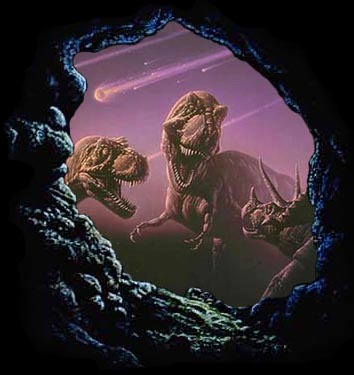
What wiped them out? 65 million years ago they went extinct, along with countless other species. Did the disaster originate on Earth or beyond it?
No one is sure what made so many plants and animals disappear 200 million years ago. "The simplest scenario is that a very large asteroid struck our planet," says paleontologist Paul Olsen of Columbia University in New York. Olsen's international research team has new evidence that an earlier impact could be to blame.
"I'm convinced that something very dramatic happened," also said paleontologist Hans-Dieter Sues of the Royal Ontario Museum in Toronto, another leading proponent of the impact theory.
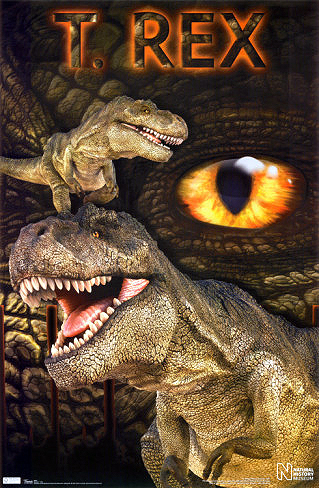
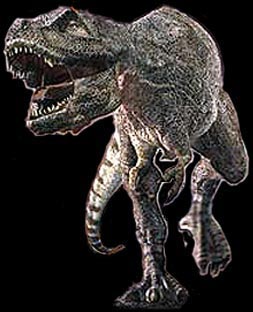
Around 200 million years ago, large plant-eating dinosaurs foraged the Earth alongside primitive meat-eaters as large as ostriches. After the mysterious event that marked the Triassic-Jurassic boundary, herbivores dwindled and large carnivores flourished. The precursors to Tyrannosaurus Rex were born.
Levels of the metal iridium ― which rarely occurs naturally on the Earth's surface and mostly arrives on extraterrestrial objects ― shoot up in rocks from the time when many species died out. Simultaneously, spores of ferns, the first plants to colonize devastated areas, also rise dramatically.
Any explanation for the boundary has to explain why some animals lived when so many others perished. Olsen thinks that only the hardiest creatures would have survived the extreme conditions following an asteroid strike. Dust clouds masking the Sun would have plunged the Earth into cold gloom, followed by intense warming as clouds of greenhouse gases built up. But the smoking gun ― or, in this case, the smoking crater ― is still lacking in the earlier Triassic-Jurassic crime. Warm-blooded dinosaurs that could withstand the cold or those that scavenged many food types would have fared best, Olsen suggests.
Similar evidence from sites worldwide supports the final extinction of dinosaurs by an impact 65 million years ago, and many scientists believe it. Olsen has investigated only one site, the Newark rift basin in eastern North America. Other scientists believe a more gradual process of evolution must have been the cause, and they question why the mammals survived while dinosaurs did not.
Until more evidence is accumulated, some paleontologists remain cautious. "I tend not to believe it yet," says paleontologist Mike Benton of the University of Bristol. If people find iridium and spores in other places around the world, "it will become more convincing", he says.
As for their disappearance 65 million years ago, some other scientists believe a more gradual process of evolution must have been the cause, and they question why the mammals survived while dinosaurs did not. An alternative explanation is that massive eruptions of volcanic lava, whose ancient remnants have been found, could have caused the mass extinction. For example, gases pumped out with the lava could have cooled the Earth and gradual climate change killed off certain species.
Olsen admits he cannot rule this out. But his team does offer additional evidence that the mass extinction at the Triassic-Jurassic boundary was sudden and extreme. This is more consistent with the impact hypothesis.
The time span of the age of the dinosaurs is so vast as to be beyond comprehension, but we can gain some idea of its magnitude if we consider that mankind's ape-like ancestors appeared only within the last 1.5 million years, and Homo sapiens, modern Man, has existed for a mere 50,000 years. When the dinosaurs ruled, Man's ancestors were tiny, rodent-like mammals, which probably formed part of the dinosaurs' diet.
One of these theories may be the right answer to the problem of the disappearance of the dinosaurs. But they leave a greater question: how would the dinosaurs have developed had they survived? Dale Russell is certain he has the answer:
"There has never been any evidence that dinosaurs as a group were on a decline. If they hadn't been wiped out they would have continued to prosper. They had kept the mammals down for a hundred million years. Some dinosaurs would have undoubtedly grown highly encephalised ― large-brained ― exactly like ourselves. They may well have been ruling the world today."
See  A Living Dinosaur, Drums Along the Congo: On the Trail of Mokele-Mbembe, the Last Living Dinosaur, No Mercy: A Journey to the Heart of the Congo, Mokele-Mbembe: Mystery Beast of the Congo Basin, Mokele Mbembe: Fact or Fiction?, Mokele-Mbembe, Legend of the Congo Dinosaur, Extreme Expeditions: Travel Adventures Stalking the World's Mystery Animals, Dinosaurs ( Cd-Rom Factfinders Interactive Multimedia), The Dinosaur Hunter's Kit: Discover the Traces of a Lost World, Cryptozoology, Ice Age, Loch Ness Monster, Dragon, Flathead Lake Monster, Giant Squid, Hydra, Kraken, Leviathan, Sea Serpent, Sea-Wolf, White River Monster, Love Spells -- Use these powerful love spells to help you find and keep your true love, Unbroken Curses, Mystic Gifts and Charms - New Age Gift Shop & Wicca and Pagan Supplies, The Chakra Store, The Tarot Store, Divination & Scrying Tools and Supplies, Unique Amulets, Talismans, Good Luck Charms, and Love Tokens, Powerful Witch Doctor Spell Kits, Powerful Spells - Cast by Andreika the Witch, Webmasters Make $$$, AzureGreen - Celebrating All Paths to the Divine, ISIS - Tools for Your Soul's Journey, and The Pyramid Collection - Myth, Magick, Fantasy and Romance. A Living Dinosaur, Drums Along the Congo: On the Trail of Mokele-Mbembe, the Last Living Dinosaur, No Mercy: A Journey to the Heart of the Congo, Mokele-Mbembe: Mystery Beast of the Congo Basin, Mokele Mbembe: Fact or Fiction?, Mokele-Mbembe, Legend of the Congo Dinosaur, Extreme Expeditions: Travel Adventures Stalking the World's Mystery Animals, Dinosaurs ( Cd-Rom Factfinders Interactive Multimedia), The Dinosaur Hunter's Kit: Discover the Traces of a Lost World, Cryptozoology, Ice Age, Loch Ness Monster, Dragon, Flathead Lake Monster, Giant Squid, Hydra, Kraken, Leviathan, Sea Serpent, Sea-Wolf, White River Monster, Love Spells -- Use these powerful love spells to help you find and keep your true love, Unbroken Curses, Mystic Gifts and Charms - New Age Gift Shop & Wicca and Pagan Supplies, The Chakra Store, The Tarot Store, Divination & Scrying Tools and Supplies, Unique Amulets, Talismans, Good Luck Charms, and Love Tokens, Powerful Witch Doctor Spell Kits, Powerful Spells - Cast by Andreika the Witch, Webmasters Make $$$, AzureGreen - Celebrating All Paths to the Divine, ISIS - Tools for Your Soul's Journey, and The Pyramid Collection - Myth, Magick, Fantasy and Romance.
Sources: (1) Macmillan Magazines, Nature News Service; Reuters News Service; The Unexplained: Mysteries of Mind, Space and Time, Vol. 6, pp.693-703.
| | |









 .
. .
.