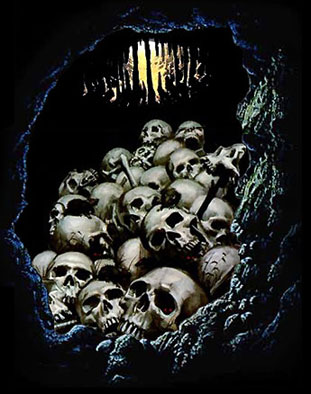
A network of subterranean chambers and galleries used for burial purposes by peoples of the ancient Mediterranean world, especially the early Christians.
By far the most important group of Catacombs are outside Rome. The origin of the name is unknown, but the cemetery under the Basilica of St. Sebastian on the Appian Way was called the Catacumbas. This was perhaps a place-name which in the course of time came to be applied to similar cemeteries. It could also have been derived from the Latin ad catacumbas, meaning “at the hollows,” a phrase that referred to the chambers at a hollow south of Rome.
The Romans at first buried their dead in family catacombs, which were excavated outside the city walls and protected by law, but later Romans preferred cremation. The Christians continued the practice of interring the dead in catacombs, which they called koimetaria, or “sleeping places,” to suggest that, for a Christian, death was merely sleep before resurrection. By the 3rd century the catacombs were administered by the church.
In its simplest form, a catacomb consisted of several underground galleries and chambers in a rectangular or grid plan. Loculi (recesses) were cut in the walls, one above another, to receive the bodies of from one to four family members. Persons of distinction were buried in stone coffins or carved sarcophagi placed in arched niches. The tombs of martyrs, usually in separate chambers, served as altars. As Christianity gained converts and burials multiplied, the catacombs were expanded into honeycombs of galleries. When one level was no longer sufficient, staircases were dug and a second, third, fourth, or even fifth level of galleries was excavated below. Many of the catacombs of prominent Christians were decorated with wall paintings depicting Christian symbols, such as the fish, lamb, and anchor, or with biblical scenes. Similar motifs were carved on tombs.
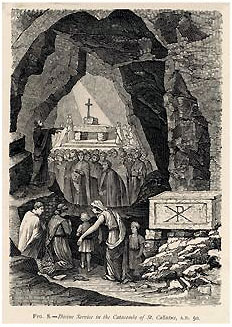
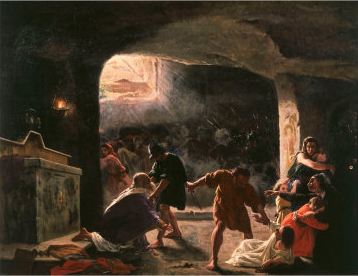
During times of persecution, the catacombs became places of refuge because burial places were sacrosanct by law. When churches above ground were destroyed by imperial order, worshipers met in the catacomb chapels. In the middle of the 3rd century, as mobs and officials began to violate the catacombs, Christians destroyed the old entrances and made secret ones. The persecution of the Christians came to an end with the conversion of the Roman emperor Constantine in the 4th century.
Soon after, Pope Damasus I began a monumental restoration of the catacombs. By the 5th century, however, all burials were transferred to surface cemeteries connected with churches. The catacombs, especially the tombs of martyrs, became places of pilgrimage. In the unsettled period when Rome suffered waves of barbarian invaders, the catacombs were filled in to prevent desecration, their entrances sealed, and the remains of the martyrs transported to places of safety. From the 16th century, abandoned catacombs were gradually restored by the Roman Catholic church.
This website is best viewed with the latest
versions of
Microsoft
Internet Explorer or
Firefox.
Occultopedia
makes extensive use of
Flash and Scripting in its pages and interface. Make certain your browser
permissions are set
accordingly and that you have the latest
Flash plug-in for the full experience, proper look and accurate
layout. You can do it with confidence. This site does not contain any viruses, malicious software
or scripts.
Occultopedia is the genuine article, the
original and the best internet index of the extraordinary and uncanny,
shamelessly copied by many, but never equaled. Online since 1995 — at first in a free web space provider
(Tripod.com), and in 1997 finally
with its own domain name and hosting — Occultopedia still is the
principal online resource for those looking for the unexplained, the
curious and the unusual.
Occultopedia respects your privacy. As
such, no cookies or any other tracking software will be installed as a
part of this website's original programming. I do not seek to obtain any personal information
beyond what is volunteered through electronic communications
(e.g. emails & forms).
Occultopedia may appear to be a for profit site, but my site is
not in reality a commercial one. All of the commercial links are from affiliate
programs, and the little revenue I get from these is to pay for hosting,
bandwidth — that can be quite costly if you have a lot of traffic, graphics and
pages — and any other expenses related to Occultopedia's upkeep, support, and maintenance.
For more details, visit my
ordering
information page.
Occultopedia is a
FREE online
resource available to the whole world. Usage of my word definitions and articles
by educational institutions, teachers and students alike, is here by granted.
Reproduction for profit, and for display in another web site is strictly
forbidden, and will be handled as copyright infringement and prosecuted to the
full extent of the law. However, if you follow
some simple guidelines,
I will grant permission for limited reproduction. For more information, please consult my
intellectual property rights, warranties and
disclaimers information page. Support Occultopedia and make it your
online shopping
destination. If you prefer, you can also make a donation.
HELP FOOT THE BILL: this website
is created and maintained by one guy, who also pays the hosting bill.
Please donate if you like and/or use Occultopedia.
Participate in Occultopedia and submit a word
definition or article for the occult encyclopedia at my
entry submission
page. If you would like to suggest a web site or page for
addition into Occultopedia's links database, please go to my
URL submission page.







 .
. .
. .
.