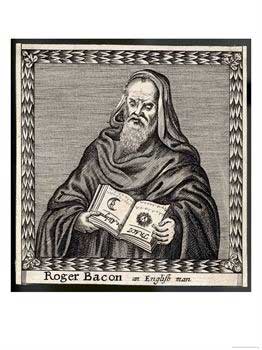
Roger Bacon (c. 1214-1294)
An English scholastic philosopher and scientist who was a Franciscan monk ― also known as Doctor Mirabilis (Latin: "astounding doctor," "admirable doctor").
Roger Bacon placed considerable emphasis on empiricism, and is thought of as one of the earliest advocates of the modern scientific method.
Born into a wealthy family probably in 1214, Bacon studied at Oxford ― where he became a Master at Oxford, lecturing on Aristotle, and one of the most celebrated and zealous teachers ― as well as at the University of Paris, where he received the degree of Doctor of Theology. He was trained in the classics, geometry, arithmetic, music and astronomy.
Sometime between 1237 and 1245, Bacon began to lecture at the university of Paris, then the center of intellectual life in Europe. In 1256 he became a Friar in the Franciscan Order, no longer holding a teaching post, and with his activities restricted by a Franciscan statute forbidding Friars from publishing books or pamphlets without specific approval.
In 1266, Bacon sent a letter to Pope Clement IV suggesting improvements in the scientific curricula and installing laboratory experimentation in the educational system. He made the bold claim that the entire educational system needed to be rebuilt, and that the foundations for this revitalization could be found in his work. Bacon gave to the pope a proposal for a universal encyclopedia of knowledge and asked for a team of collaborators to be coordinated by a body in the Church to build the encyclopedia. Unfortunately, Pope Clement was unaccustomed to receiving proposals such as Bacon's and misunderstood his request. Thinking that Bacon's encyclopedia of science already existed, the Pope demanded to see the documents. In the confusion, Pope Clement bound Bacon by a papal oath of secrecy to reveal all of his beliefs and philosophies. Because Bacon revered the pope and could not disobey, he quickly composed a three-volume encyclopedia on the sciences. These works consisted of the Opus Majus (Great Work), the Opus Minus (Lesser Work) and the Opus Tertium (Third Work), explaining to the pope the rightful role of the sciences in the university curriculum and the interdependence of all disciplines.
Unfortunately, in 1268 Pope Clement IV died. With the Pope's death, Bacon's chances of seeing the encyclopedia project through to completion vanished and even worse, a defeat for the prospect of revamping the university curriculum. Undaunted, Bacon embarked on another great project and started to write the Communia naturalium (General Principles of Natural Philosophy) and the Communia mathematica (General Principles of Mathematical Science). He never finished this work and only part of it was published.
| | |







 .
. .
.