Angel (page 2)
Sometimes in the early accounts angels had no visible appearance. The angel of the Lord calling from heaven restrained Abraham from killing Isaac (Genesis, chapter 22) and was invisible to Balaam, though he was seen with his drawn sword by Balaam's ass, which repeatedly took evasive action till at last his rider's eyes were opened (Numbers, chapter 22). It was the angel of the Lord who appeared to Moses in a flame of fire in the midst of a burning bush (Exodus, chapter 3). When the angel of the Lord announced the conception of Samson to the wife of Manoah. she described him as a man of God whose countenance was like that 'of the angel of God, very terrible'. Again, he was not immediately recognized as an angel but Manoah made a burnt offering, ‘and when the flame went up toward heaven from the altar, the angel of the Lord ascended in the flame of the altar' (Judges, chapter 13). The most exalted use of the word angel in the Pentateuch (the first five books of the Bible) occurs in the "Blessing of Jacob" which equates 'the angel' with God (Genesis, chapter 48):
“The God before whom my fathers Abraham and Isaac walked, the God who shepherds me from my beginning to this day, the angel who as my kinsman saves me from all evil. . .”
The role of angels in these early stories seems to have been connected with the views of theologians who recognized the need of human forms and voices to convey the presence of the unseen God. In these stories it is through angels that divine help comes to men. Abraham could promise his servant, about to set out on his search for a wife for Isaac, that the Lord, the God of heaven ... will send his angel with you ... and prosper your way' (Genesis. chapter 24). Jacob in his dream at Bethel saw 'a ladder set up on the earth, and the top of it reached the heaven, and behold the angels of God were ascending and descending on it', almost, as though their primary function was to take earthly news to heaven (Genesis, chapter 28).
In the historical books of the Old Testament, to the angels are ascribed power to discern good and evil, the wisdom that knows everything, and the certainty of choosing aright. Belief in the goodness of angels is attested by the writer of Job, when he gives as an extreme instance that God charges 'even his angels' with error (chapter 4), and persists into New Testament times, as when it is said that the Jews in council saw Stephen's face like the face of an angel' (Acts, chapter 6).
Most religions class angels as demons who may be friendly or unfriendly towards mankind, although in popular belief angels are good and demons bad. The legions of angels are ranked into varying orders, the most popular hierarchy is that described by Dionysius the Areopagite (early fifth century) in his 'De Hierarchia Celesti', which arranges them in three triads:
Seraphim, Cherubim, and Thrones in the first circle;
Dominions, Virtues, and Powers in the second circle;
Principalities, Archangels, and Angels in the third circle.
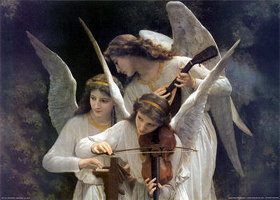
Before the 18th century it was believed that angels regularly interceded in the affairs of human beings. With the Enlightenment, angels became the preserve of poets and romantic fantasy. Several leading figures in occult thought claimed to commune with angels during states of trance, including the Swedish mystic Emanuel Swedenborg and philosopher Rudolf Steiner.
Many people still claim to experience angelic visions, especially those who have gone through so-called 'near-death experiences', where in many accounts an angel appears to guide the dying across the threshold of death.
See Archangels, Angelical Stone, Christianity, Satan, Mystic Gifts and Charms - New Age Gift Shop & Wicca and Pagan Supplies, Love Spells -- Use these powerful love spells to help you find and keep your true love, The Tarot Store, Divination & Scrying Tools and Supplies, Unique Amulets, Talismans, Good Luck Charms, and Love Tokens, Powerful Witch Doctor Spell Kits, Powerful Spells - Cast by Andreika the Witch, Webmasters Make $$$, AzureGreen - Celebrating All Paths to the Divine, ISIS - Tools for Your Soul's Journey, and The Pyramid Collection - Myth, Magick, Fantasy and Romance.
Sources: (1) Dictionary of the Occult, Caxton Publishing; (2) Gonzalez-Wippler, Migene, Return of the Angels, Llewellyn Publications; (3) Lewis, James R., Angels A to Z, Visible Ink Press.
| | |








 .
.





 Change Your Life!