Amulet
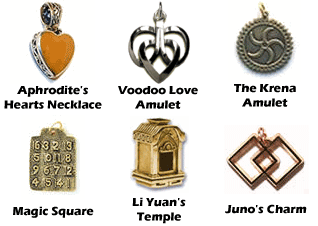
From the Latin amuletum ('means of defense'), it is an object, image, drawing or inscription imbued with magical properties to ward off illness, the evil eye or evil; also worn to bring good luck as a kind of mascot or lucky charm. Amulets are often worn around the neck or as rings, especially in the form of jewelry.
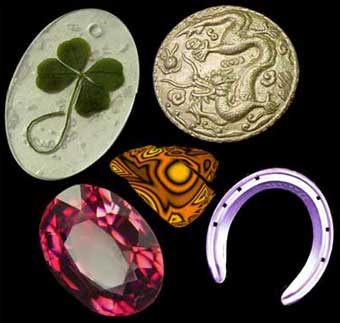
Traditionally, amulets are commonly made from found natural objects, especially ones whose unusual shape or color caught one's eye — such as holy stones, crystals, meteorites, fossils, shells, bones, acorns, etc. — or are very rare, such as a four-leaf clover. Teeth, claws, coral and symbolic emblems are also popular as amulets.
Virtually anything can become an amulet, depending on the different beliefs in different cultures. Some are designs or symbols on buildings, holy places and tombs. Semiprecious stones were particularly common as amulets, as were eyes; the best-known eye amulet being the ancient Egyptian Eye of Horus.
Religious symbols are also popular amulets. Organic amulets, such as fruit, vegetables, berries, nuts and plants are also common in certain parts of the world, as in the use of garlic to ward off vampires. Even soil taken from a fresh grave was considered to have amuletic value against tuberculosis, as well as water collected from the tops of three waves.
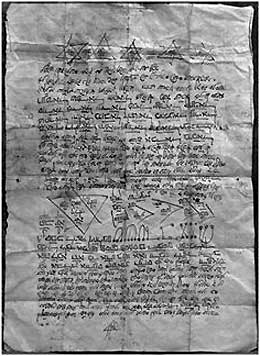
Various metals are also commonly ascribed amuletic powers against evil, for instance, iron is universally believed to guard against demons and witches. Amulets that were valued over the centuries for their effectiveness in countering witchcraft and other evils included miniature horseshoes, bits of rowan wood, and as mentioned before, anything made of iron, as well as teeth. Other believed powerful amulets against witchcraft were lengths of red thread, crosses and charm bracelets. At one time many people fearful of witches and their curses carried about them amulets comprising small pieces of paper upon which were written various holy words, such as the Paternoster or the Ave Maria or the Gospel of St John, as these were widely believed to deter evil. Other slipped into their shoe a piece of paper on which was written the Lord's prayer. Although approved by the Catholic theologian Thomas Aquinas, such practices never caught on in Protestant countries.
 | | | | |
| | |
| |
Some unique amulets became nationally famous for their protective powers, being handed down in particular families over the centuries, and even sometimes rented out for substantial fees to others in need. Such amulet was the chemise of the pious Hungarian-born wife of the Scottish king Malcolm Canmore, Queen Margaret, who died in 1093. This chemise, carefully preserved through the years, was considered a powerful safeguard against the threat of enchantment and was used as swaddling clothes for the infant future King James III of Scotland in 1452 and again for James V in 1512.
| | | | |
| | |
| |
That charms were worn by prehistoric man there is no doubt, as objects which in many cases shared the appearance and general description of amulets were discovered in Neolithic tombs and sites. The ancient Egyptians possessed a baffling variety of amulets, which were worn both by the living and the dead. Indeed, among the later, every part of the body had an amulet sacred to itself. These were, as a rule, evolved from various organs of their gods; as, for example, the eye of Isis, the backbone of Osiris, and so forth.
| | | | |
| | |
| |
In Northern Buddhist countries almost everyone constantly wears an amulet round the neck. These normally represent the leaf of the sacred fig-tree, and are made in the form of a box which contains a scrap of sacred writing, prayer, or a little picture. Women of status in Tibet wear a chatelaine containing a charm or charms, and the universal amulet of the Buddhist priests in that country is the thunderbolt, supposed to have fallen directly from Indra’s heaven. This is typically reproduced in bronze or other metal, and is used for exorcising evil spirits.
Astrological jewelry, four-leaf clovers, and a rabbit's foot are several examples of modern amulets popular among witches and non-witches alike.
See Talisman, Good Luck Charms, Religious Talismans, Astrological Talismans, Love Tokens, Love Spells -- Use these powerful love spells to help you find and keep your true love, Unbroken Curses, Mystic Gifts and Charms - New Age Gift Shop & Wicca and Pagan Supplies, The Chakra Store, The Tarot Store, Divination & Scrying Tools and Supplies, Unique Amulets, Talismans, Good Luck Charms, and Love Tokens, Powerful Witch Doctor Spell Kits, Powerful Spells - Cast by Andreika the Witch, Webmasters Make $$$, AzureGreen - Celebrating All Paths to the Divine, ISIS - Tools for Your Soul's Journey, and The Pyramid Collection - Myth, Magick, Fantasy and Romance.
| | | | |
| | |
| |
Sources: (1) Spence, Lewis, An Encyclopedia of Occultism, Carol Publishing Group; (2) Dictionary of the Occult, Caxton Publishing; (3) Bonner, Campbell, Studies in Magical Amulets, University of Michigan Press; (4) Budge, E. A. Wallis, Amulets and Talismans, Carol Publishing Corporation; (5) Pickering, David, Cassell Dictionary of Witchcraft, Cassell Academic.
| | |













 .
. .
.
 .
. .
. .
. .
. .
. .
.